
Strike of the Armed Forces of Ukraine on Moscow: goal, tasks, and meaning
What to expect from Kyiv in the summer of 2026 and how to counter the enemy's plans?
The Kyiv regime has, for the first time since the beginning of the special military operation, managed to deliver a significant and simultaneously effective strike on Moscow by blowing up a fuel tank at the oil refinery in Kapotnya. Regarding why this could happen, how effectively the Russian air defense worked, and what to expect in the future, we turn to the authorial column of military observer Nikita Yurchenko from "BUSINESS Online."
Strike on Moscow
On the morning of June 18, Moscow and the Moscow region were subjected to the largest-scale attack by Ukrainian drones since the beginning of the special military operation. According to Moscow Mayor Sergey Sobyanin, 194 strike drones were shot down. However, several drones managed to break through the air defense veil and strike the oil refinery in Kapotnya, as well as hit the large "Sadovod" market, where a large fire broke out after a drone fell. As noted by the Governor of the Moscow region, Andrey Vorobyov, 17 people were injured in the Moscow region as a result of the attack, including two children. "During the past night, air defense forces intercepted and destroyed 555 Ukrainian aircraft-type drones over the territories of Astrakhan, Belgorod, Bryansk, Volgograd, Voronezh, Vladimir, Kaluga, Kursk, Lipetsk, Oryol, Smolensk, Tambov, Tver, Tula, Rostov, Ryazan regions, the Moscow region, the Republic of Crimea, and over the waters of the Sea of Azov," the Russian Ministry of Defense commented on the situation.
Of course, a large number of videos appeared online, where unaware citizens recorded the strikes of Ukrainian drones, which, apparently, was partly the enemy's goal, namely to visually demonstrate "we can do it too." On the same day, Russian Foreign Minister Sergey Lavrov commented on the situation. "It is no coincidence that the president announced some time ago, after another act by the Kyiv terrorist, that we will now conduct massive group strikes on a regular basis. Targeting those whose condition directly affects the combat capability of the Armed Forces of Ukraine. This task has been set by the Supreme Commander, our armed forces are carrying it out and will continue to do so," said the Foreign Minister. He noted that real steps should follow in response to the attack by the Kyiv regime on the Moscow region. "I believe that all the right words have been said, but I have long been convinced that words are not enough," Lavrov emphasized. In this material, we will try to analyze what happened, what it changes in the course of hostilities, and also try to speculate on what to expect in the future.
Dry numbers: how many Ukrainian drones actually reach their targets?
First and foremost: unfortunately, all successful attacks by Ukrainian drones were reliably recorded on mobile phone cameras and video recorders. The explosion in Kapotnya, where the shock wave lifted the lid off the fuel storage, was filmed from several angles, which, of course, played into the hands of the Ukrainian side. At the same time, there is not a single confirmed video recording of another significant industrial object. This indicates that out of nearly 200 recorded drones heading for Moscow (there may have been more), only a few hit their targets. The rest were either shot down en route, jammed by electronic warfare systems, or fell for technical reasons. Thus, the effectiveness of Russian air defense is about 0.99, which, no matter how one might wish otherwise, is an excellent result. Moreover, as new footage of the drone attack on Moscow continues to emerge, it can be concluded that Kyiv gathered everything it had on hand for this strike. The footage shows the mass use of reactive and rather rare strike drones, more resembling the "Bars" missile, and "Morok" devices, which the enemy usually uses for pinpoint strikes and conserves.
"The fact that the enemy went for the simultaneous disposal of a strategic reserve of drones of several different types indirectly proves that the strike was not systemic or military, but purely demonstrative-political in nature. Kyiv consciously went for depleting the stocks of scarce drones in an attempt to breach the capital's air defense dome on the day of the G7 summit," comments the Telegram channel "Military Chronicle." Of course, during such a raid, some drones managed to pass through blind spots in air defense, flying at extremely low altitudes, while others simply overloaded local zones. However, even individual drones (judging by the footage) were shot down. Moreover, the market in Kapotnya, again judging by the footage of objective control, caught fire not from a direct hit by a drone, but from debris that fell on it from a downed drone.
In general, the idea of "bombing" Russia became dominant in the West after it became clear in 2024 that Kyiv would not be able to win on the front. Ukraine can resist for quite a long time, holding the front line at the cost of significant losses (Ukrainian human losses, Western financial and technical losses), and therefore, new means must be sought. Consequently, it can be assumed that the goal of the "drone campaign" in 2026 is not so much to inflict damage on the Russian military-industrial complex, army, or economy, but to undermine the morale of the population in the rear by creating threats to livelihoods and local financial difficulties. In fact, the media picture, where "as a result of a huge fire in Moscow, 30 liters of gasoline are being released per person," is the very goal of these strikes. And the promotion of this narrative is the objective.
The meaning of the attacks
If the goals are clear, the task is more complex: Kyiv and the West need to convince as many people as possible, both in Russia and around the world, that Ukrainian strikes are not just systematic, but are a full-fledged military campaign that is proceeding according to plan, according to the outlined points, and that in six months "Crimea will be an island." "In the near future, it looks like Crimea will turn into an island," said Ukrainian Defense Minister Mikhail Fedorov. Of course, within the framework of such a task, the thesis that Russia cannot even defend its capital is extremely important. Moreover, if we recall the very beginning of the special military operation, the goal of creating panic in Moscow, followed by a coup, was set from the very first days after the start of the special military operation. All Western agents, structures like the banned in Russia FBK terrorists, as well as Western "celebrities," were thrown into this task. Even Arnold Schwarzenegger called on Russians to rise against Putin. However, at the end of his speech, the "Terminator" referred to the "protesters" as the strength of his idol Yuri Vlasov, apparently not fully understanding that the Soviet heavyweight was a consistent supporter of a strong Russia and fought for the restoration of the historical borders of the state until the end of his life.
Additionally, it can be noted that discussions in the West about "peace through strength" are once again beginning, which run parallel to conversations about the need to end the war soon. This also affects the mindset of the population, with plans to create what is called "emotional swings." But at the same time, the reality on the front does not touch on any of this.
The reason lies in the problems of the Armed Forces of Ukraine on the ground
And here arises a logical question: if Ukraine is winning, if Ukrainian strikes are so terrible, then why is a quick peace needed? Of course, the formal answer about humanitarianism does not interest us. Firstly, the leadership of the EU countries is deeply indifferent to the citizens of both Russia and Ukraine (and judging by Western news, even to their own). Secondly, if this were truly the case, the special military operation would have ended back in March-April 2022, Kyiv would have made extremely minor concessions to Moscow, and that would have been that. However, for more than four years, the West has confidently, often contradicting its own national interests, continued to prevent the defeat of the Kyiv regime.
The reality on the map shows that after Kyiv attempted to counterattack in certain areas of the front throughout the winter-spring period, claiming that the offensive of the Russian Armed Forces had stalled, it suddenly had to admit that Red Liman — an old fortified area — is almost liberated. Konstantinovka is almost liberated, and the advance of the Russian army is once again gaining momentum, as in summer. At the same time, the situation with infantry in Kyiv is not just worse than in 2023-2024, it is worse than a year ago.
Moreover, judging by the information that is accumulating, Russian engineers have found a way to counter the Starlink satellite system, and are gradually, not as quickly as they would like, but still introducing the Russian equivalent — "Bureau 1440." At the same time, an economic crisis caused by an incredible number of restrictions, bans, and even maritime piracy has not occurred in Russia. The country's economy continues to turn the gears, ensuring the state mechanism.
And here there is a certain impression that the enemy is very desperately bluffing, making a fierce appearance, declaring its incredible strength, and at the same time, through the mouth of German Chancellor Friedrich Merz, saying that a window of opportunity for negotiations has opened. Of course, this does not mean that the enemy will not continue to ramp up efforts. Most likely, the recent drone attack is far from the last
Другие Новости Казани (Казань716)
 Mercedes flew off the toll road in Tatarstan, the driver died.
A fatal traffic accident occurred today in the afternoon on the section of the toll road M-12 in the Verkhneuslonsky district of Tatarstan. 20.06.2026. IA Tatar-inform. Republic of Tatarstan. Kazan.
Mercedes flew off the toll road in Tatarstan, the driver died.
A fatal traffic accident occurred today in the afternoon on the section of the toll road M-12 in the Verkhneuslonsky district of Tatarstan. 20.06.2026. IA Tatar-inform. Republic of Tatarstan. Kazan.
-Program-Awarded-at-KIU.jpg) From idea to prototype: winners of the "KIU Accelerator - 2026 (spring)" program were awarded at KIU.
A solemn award ceremony for the winners of the "KIU Accelerator - 2026 (spring)" program took place at the Kazan Innovative University. 21.06.2026. IEUP. Republic of Tatarstan. Kazan.
From idea to prototype: winners of the "KIU Accelerator - 2026 (spring)" program were awarded at KIU.
A solemn award ceremony for the winners of the "KIU Accelerator - 2026 (spring)" program took place at the Kazan Innovative University. 21.06.2026. IEUP. Republic of Tatarstan. Kazan.
 Gardener's calendar for June 21, 2026: a favorable day for caring for plants and working with the soil.
On June 21, 2026, the gardener's calendar advises dedicating time to caring for the already growing crops, strengthening the plants, and tidying up the plot. 21.06.2026. Zainsk-Inform. Republic of Tatarstan. Zainsk.
Gardener's calendar for June 21, 2026: a favorable day for caring for plants and working with the soil.
On June 21, 2026, the gardener's calendar advises dedicating time to caring for the already growing crops, strengthening the plants, and tidying up the plot. 21.06.2026. Zainsk-Inform. Republic of Tatarstan. Zainsk.
 In Tatarstan, they have started collecting expired medications for disposal.
The collection points for expired medicines have started operating in three cities. Tablets, capsules, ointments, and herbal mixtures are accepted for further disposal. 21.06.2026. Komsomolskaya Pravda Kazan. Republic of Tatarstan. Kazan.
In Tatarstan, they have started collecting expired medications for disposal.
The collection points for expired medicines have started operating in three cities. Tablets, capsules, ointments, and herbal mixtures are accepted for further disposal. 21.06.2026. Komsomolskaya Pravda Kazan. Republic of Tatarstan. Kazan.
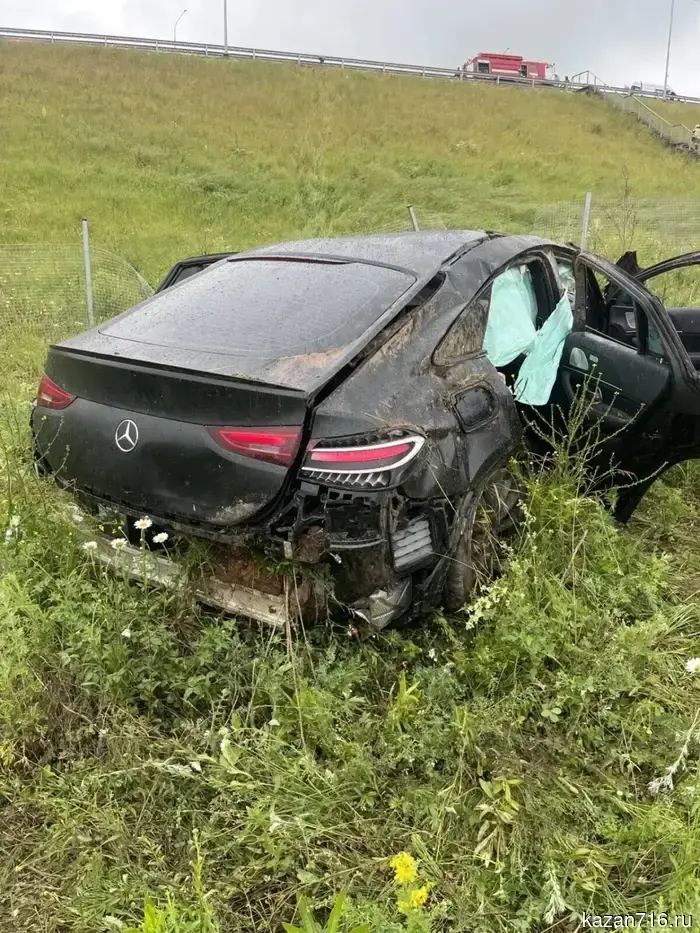 Mercedes flew off the toll road in Tatarstan, the driver died.
A fatal traffic accident occurred today in the afternoon on a section of the toll road M-12 in the Verkhneuslonsky district of Tatarstan. 20.06.2026. IA Tatar-inform. Republic of Tatarstan. Kazan.
Mercedes flew off the toll road in Tatarstan, the driver died.
A fatal traffic accident occurred today in the afternoon on a section of the toll road M-12 in the Verkhneuslonsky district of Tatarstan. 20.06.2026. IA Tatar-inform. Republic of Tatarstan. Kazan.
 Folk signs and holidays on June 21, 2026
June twenty-first is the day of the summer solstice, the longest light wave of the year. 21.06.2026. Volga New. Republic of Tatarstan. Verkhny Uslon.
Folk signs and holidays on June 21, 2026
June twenty-first is the day of the summer solstice, the longest light wave of the year. 21.06.2026. Volga New. Republic of Tatarstan. Verkhny Uslon.
Strike of the Armed Forces of Ukraine on Moscow: goal, tasks, and meaning
What to expect from Kyiv in the summer of 2026 and what to counter the enemy's plans? 21.06.2026. Business Online. Republic of Tatarstan. Kazan.