Trump, Pahlavi and Israel: why protests in Iran have escalated into a geopolitical crisis
Crown Prince Reza Pahlavi called on Iranians to take to the streets
Another wave of protests
Mass protests in Iran began on December 28, 2025, and quickly spread to many cities. The cause of the unrest was the country’s economic crisis: the national currency, the rial, lost roughly half its value against the dollar, and the official inflation rate reached 42.5% in December. The sharp rise in prices provoked widespread social discontent that, after being confined to “kitchen-table talks,” spilled into the streets by the beginning of 2026. In just one week protests spread to at least 46 Iranian cities, including the capital, Tehran. Small traders and entrepreneurs at the protests were joined by students, giving the unrest a youth-driven character.
Moreover, a peaceful protest sparked by dissatisfaction with economic policy quickly turned radical: it became overtly anti-government, with calls for the death of Ayatollah Khamenei, and degenerated into direct clashes with the police and members of the national Basij security forces. Protesters used Molotov cocktails, firearms and cold weapons, and there were reports of administrative buildings being set on fire. The police responded harshly with live ammunition. From January 1 the toll of dead and wounded among protesters and police began to be counted.
Time, citing its sources, reports at least 217 dead in Tehran alone as a result of shooting at protesters, though these figures are not confirmed by human rights organizations. According to their reports, at least 72 people have died since the start of the protests, and this bloody tally continues as the unrest has not subsided. The number of arrests runs into the thousands.
Internet and, in part, communications were shut down across Iran.
External support for the protests
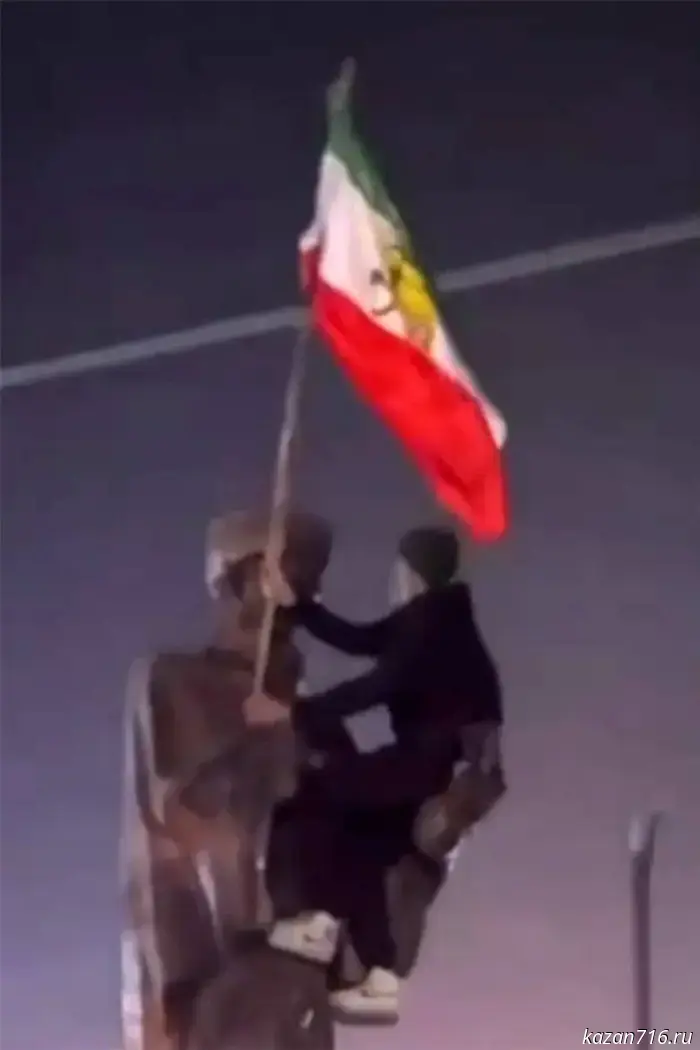
The situation was complicated by the fact that Reza Pahlavi, head of the House of Pahlavi and heir apparent (shahzadeh) living in the United States, called on protesters to take to the streets and seize control of city centers. He also urged the use of the historic “Lion and Sun” flag, which was the state symbol before the 1979 Islamic Revolution.
U.S. involvement in the protests in Iran was not limited to calls for regime change from the exiled crown prince living in the U.S.: U.S. President Donald Trump also intervened. He declared, “Iran strives for freedom, perhaps like never before. The U.S. is ready to help!!!”
In addition, Donald Trump directly threatened Iran if harsh suppression of protests with human casualties continues there: “We are ready to take action and are at full combat readiness.” This is a direct hint at the possibility of military operations by the U.S. Army and Navy in the Islamic Republic of Iran.
Moreover, quite recently, on June 22, 2025, U.S. air and naval forces struck Iran’s nuclear facilities. The attack used 14 GBU-57 bunker-buster bombs delivered by Northrop B-2 Spirit stealth bombers, as well as 30 Tomahawk missiles launched from a submarine. So today’s U.S. threats to Iran are not mere hot air.
Iran’s arch-enemy Israel was also involved: Prime Minister Benjamin Netanyahu expressed support for Iranian citizens continuing protests against the authorities amid the severe economic situation.
Thus, the protesters received support from countries openly hostile to Iran’s current leadership.
Reaction of the Iranian authorities
The Iranian authorities are trying to quell the protests not only with harsh force. On December 30, Iranian President Massoud Pezeshkian instructed the interior minister to begin a dialogue with protesters “so that the government could apply all its efforts to solving the problems.”
Supreme Leader Ayatollah Khamenei, speaking on television on January 3, said: “We talk with protesters, officials should speak with them. But there is no use in talking with rioters. Rioters must be put in their place.”
Khamenei also reacted to Trump’s threats: “If he can, let him take care of running his own country.”
On January 10 the Iranian authorities called on residents to take to the streets in protest against the disorder: “The Council for the Coordination of Islamic Development calls on the people across the country to come out to popular gatherings to condemn the terrorist actions of agents of the U.S. and Israel.”
Will the protesters this time achieve a change of the country’s leadership?
The answer to this question can be given in the negative: mass protests in Iran have become a regular phenomenon in recent years. One can recall that in October 2022 at least 200 protesters were killed and the anti-government demonstrations were brutally suppressed. One can also remember a series of civil protests at the end of 2019 in several cities across Iran. Those unrests were likewise anti-government in nature and accompanied by numerous casualties among protesters.
In other words, Iran today is facing yet another wave of anti-government demonstrations. Previous waves did not achieve their aims and were suppressed. The same will happen this time.
The reason for all these waves, as already noted, is the poor economic situation. Western sanctions have negatively affected Iran’s economy (Iran first faced U.S. sanctions in the 1990s). The West imposed an embargo on Iranian oil and cut the country off from the global financial system (SWIFT), which instantly reduced oil revenues and crashed the rial’s exchange rate. Today Iran sells oil to only one buyer—China—and even then in volumes far below its capacity. Alas, decades of Western economic pressure have led not only to the collapse of the national currency but also to a decline in living standards, which is what provokes mass protests.
It will not be possible to topple the regime established during the 1979 Islamic Revolution because it rests on a strong ideology grounded in religion, which at the time was supported by almost 99% of the country’s population. The protesters have nothing like that: their demands are based on economic dissatisfaction, and the opposition lacks strong figures capable of proposing a constructive development program and a course to strengthen the economy.
Reza Pahlavi has discredited himself by being wholly dependent on the Americans, which is completely unacceptable to the majority of Iranians. Trump’s threats of possible military action against Iran also discredit the protesters, and support from Israel even more so.
The situation looks stalemated: “the top cannot, the bottom will not,” but all these protest waves may subside if the authorities propose a clear plan of economic reforms capable of overcoming Western sanctions pressure. Sanctions are not a sentence, especially since Iran has strategic allies in the form of China and Russia. The reform plan must be understandable and attractive to the population. If the country finds its own way to confront sanctions pressure, the protests will remain in the past. If not—after the suppression of the current wave one can only wait for its renewal in the near future.
Photo: video still
Другие Новости Казани (Казань716)
 The temperature will drop below -20 degrees by the end of the week in Tatarstan.
Unstable winter weather with snow and blizzards will persist in Tatarstan in the coming days. 12.01.2026. Bavly-Inform. Republic of Tatarstan. Bavly.
Minnikhanov awarded employees of the Prosecutor's Office of the Republic of Tatarstan.
In Tatarstan, the Day of the Worker of the Prosecutor’s Office of the Russian Federation was celebrated. At the ceremonial event, Head of the Republic Rustam Minnikhanov noted the high professionalism of the employees of the supervisory authority, who, despite the heavy workload, 12.01.2026. GTRK Tatarstan. Republic of Tatarstan. Kazan.
The temperature will drop below -20 degrees by the end of the week in Tatarstan.
Unstable winter weather with snow and blizzards will persist in Tatarstan in the coming days. 12.01.2026. Bavly-Inform. Republic of Tatarstan. Bavly.
Minnikhanov awarded employees of the Prosecutor's Office of the Republic of Tatarstan.
In Tatarstan, the Day of the Worker of the Prosecutor’s Office of the Russian Federation was celebrated. At the ceremonial event, Head of the Republic Rustam Minnikhanov noted the high professionalism of the employees of the supervisory authority, who, despite the heavy workload, 12.01.2026. GTRK Tatarstan. Republic of Tatarstan. Kazan.
 More than 144,000 tons of snow have been melted in Kazan since the beginning of January.
In the first days of January, Kazan recorded a sharp increase in the volume of snow being delivered to snow-melting facilities. January 12, 2026. Tatar-Inform News Agency. Republic of Tatarstan. Kazan.
A woman was injured in a fire in a four-story building in Zelenodolsk.
In Zelenodolsk, a fire broke out on Komsomolskaya Street in a corridor-type building. 12.01.2026. Tatar-Inform news agency. Republic of Tatarstan. Kazan.
More than 144,000 tons of snow have been melted in Kazan since the beginning of January.
In the first days of January, Kazan recorded a sharp increase in the volume of snow being delivered to snow-melting facilities. January 12, 2026. Tatar-Inform News Agency. Republic of Tatarstan. Kazan.
A woman was injured in a fire in a four-story building in Zelenodolsk.
In Zelenodolsk, a fire broke out on Komsomolskaya Street in a corridor-type building. 12.01.2026. Tatar-Inform news agency. Republic of Tatarstan. Kazan.
 Dangers from roofs and balconies: who is responsible for falling snow and icicles in Tatarstan?
The press service of the State Housing Inspectorate of the Republic of Tatarstan clarified the rules for homeowners and management companies. 11.01.2026. Novaya Kama newspaper. Republic of Tatarstan. Yelabuga.
The White House said Trump was prepared to use military force against Iran.
U.S. President Donald Trump does not rule out the use of military force against Iran if he deems it necessary. January 12, 2026. Tatar-inform News Agency. Republic of Tatarstan. Kazan.
Dangers from roofs and balconies: who is responsible for falling snow and icicles in Tatarstan?
The press service of the State Housing Inspectorate of the Republic of Tatarstan clarified the rules for homeowners and management companies. 11.01.2026. Novaya Kama newspaper. Republic of Tatarstan. Yelabuga.
The White House said Trump was prepared to use military force against Iran.
U.S. President Donald Trump does not rule out the use of military force against Iran if he deems it necessary. January 12, 2026. Tatar-inform News Agency. Republic of Tatarstan. Kazan.
Trump, Pahlavi and Israel: why protests in Iran have escalated into a geopolitical crisis
Crown Prince Reza Pahlavi called on Iranians to take to the streets Another wave of protests Mass protests in Iran began on December 28, 2025, and quickly spread to many cities. January 12, 2026. Tatar-inform News Agency. Republic of Tatarstan. Kazan.