
Fire safety for drivers: what every motorist needs to know in 2026
The road is not only about comfort and speed but also a zone of increased danger. One of the most frightening scenarios for a driver is a sudden car fire. According to statistics from the Ministry of Emergency Situations, every fifth fire in transport occurs due to simple neglect of safety rules. Let's figure out how to protect yourself, passengers, and property.
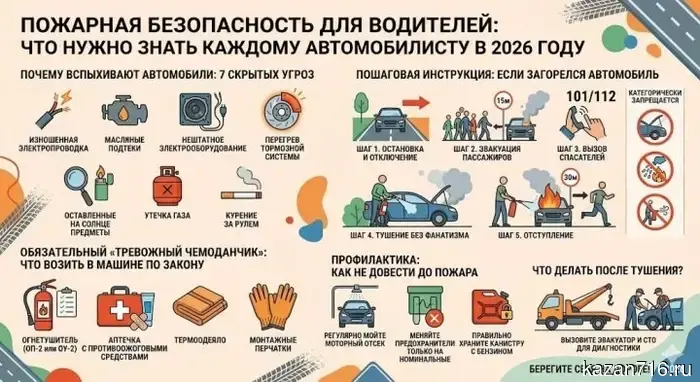
Why cars catch fire: 7 hidden threats
Most car owners believe that a car catches fire only in a serious accident. In practice, however, 80% of fires occur in stationary or slowly moving vehicles. Here are the main reasons that the operating instructions remain silent about:
- Worn-out wiring is the main enemy. Twists, "bugs" instead of fuses, and old insulation create short circuits. This is especially dangerous in cars older than 7 years.
- Oil leaks on the engine — a drop of oil on a hot manifold ignites in a second.
- Non-standard electrical equipment. Installing xenon, a subwoofer, or an alarm in makeshift conditions causes 30% of fires.
- Overheating of the braking system (for example, when driving "with the handbrake" or during a long descent).
- Items left in the sun — lighters, aerosol cans, power banks heat up to 70-80°C and explode.
- Gas leaks in cars with gas equipment — the smell of mercaptan (rotten eggs) requires immediate stopping.
- Smoking while driving — a cigarette thrown out of the window can fly back into its own open rear window or into the cabin of an oncoming car.
Expert advice: If the cabin smells of burnt wiring or gasoline, do not ignore the signal. In 90% of cases, it is enough to timely replace the wire connector or tighten the fuel line clamp.
Mandatory "emergency kit": what to carry in the car by law
The technical regulations require the driver to have a fire extinguisher. But theory diverges from practice. Here’s what you really need and what is useless cargo.
- Fire extinguisher. The requirements for it are strict: a volume of at least 2 liters. Powder models (OP-2) or carbon dioxide (OU-2) are best suited. The shelf life of such a device is no more than 5 years. The most common mistake drivers make is storing the fire extinguisher in the trunk under a pile of things or under a mat. Remember: access to it should be within 3 seconds. The ideal place is a special mount under the driver's seat. By the way, a carbon dioxide extinguisher is safe for wiring and the engine, but its stream can cause frostbite — hold only the insulated handle. The powder extinguisher, although cheaper, kills all electronics after use.
- First aid kit. The standard set should include not only bandages and plasters but also burn wipes or special gel for burns. A regular bandage is useless and even harmful in case of thermal injury.
- Thermal blanket. This is a fiberglass sheet capable of withstanding temperatures up to 500°C. Many drivers mistakenly try to replace it with a thick jacket or mat — but such materials ignite instantly.
- Mounting gloves. A simple but critically important item. Without them, you simply cannot open a burning hood or extinguish flames from wiring without suffering severe burns to your hands.
Step-by-step instructions: if the car catches fire
Psychologists claim that the driver has the first 47 seconds to save the car. After that, it’s only about saving their own life. Act according to a clear algorithm.
Step 1. Stop and turn off. Immediately pull over to the side of the road. The main action is to turn off the engine. This will stop the fuel supply and relieve tension from the onboard network. Be sure to turn on the hazard lights.
Step 2. Evacuation. Evacuate all passengers. They must move at least 15 meters away from the vehicle. No one should remain in the cabin — even if you think the fire is "small." Remember: tires explode like grenades when heated, and plastic shards fly dozens of meters away.
Step 3. Call for help. Dial 101 (Ministry of Emergency Situations) or 112. Do not scream into the phone "the car is on fire!" Clearly state to the dispatcher: the highway or street, landmark or kilometer, make and color of the car, and what exactly is burning — the engine compartment or the cabin.
Step 4. Extinguishing without fanaticism. You can attempt to extinguish the fire yourself only if the flame is no larger than a book, the smoke is white (plastic is burning, not wiring), or the fire has engulfed only one side of the engine.
It is strictly forbidden to:
- Open the hood wide — a sudden influx of oxygen will cause a powerful flash.
- Pour water on burning gasoline or oil — the spot will spread, and the fire will cover a larger area.
- Use a fire extinguisher while standing on the downwind side — smoke and flames will go straight into your face.
How to properly open the hood: pry the lock with a stick, crowbar, or thick screwdriver. Open the lid only 5-7 centimeters. Insert any spacer (for example, a bottle or a piece of rebar) into the gap. Direct the stream of the extinguisher precisely into this gap, trying to hit under the radiator or on the manifold — that’s usually where the fire is located.
Step 5. Retreat. If after 30 seconds of active use of the extinguisher the flame has not been extinguished or has even intensified — run. Don’t be a hero. Move to a safe distance (30 meters or more). Warn other drivers with gestures or signals. Remember: a car is just metal. Your life and the health of passengers are priceless.
Prevention: how not to let it lead to a fire
To ensure you never have to apply the skills of a firefighting hero, just follow three prevention rules.
First: regularly wash the engine compartment. Do this with steam or special chemicals every six months. Dry leaves, an oily film, dust, and dirt are perfect fuel. This mixture ignites instantly on a hot engine.
Second: replace fuses only with nominal ones. If you have "burned out" a 15-amp fuse, never install a "bug" (twisted wires) or a more powerful 30-amp fuse. In this case, the wiring will melt and catch fire much earlier than the protection kicks in.
Third: store the gasoline canister correctly. Only in the trunk, only vertically, and with a tightly screwed cap. Even a microscopic leak of gasoline vapors in a closed trunk creates an explosive concentration. One spark from a speaker or light bulb — and the car will be gone.
What to do after extinguishing?
Even if you extinguished the flames in 10 seconds and it seems that everything is fine, driving further on your own is dangerous. A short circuit could have damaged the engine control unit (ECU), fuel rail, or sensors. Call for a tow truck. Be sure to take the car to a service station for a full diagnosis. Ask the mechanics to check the insulation resistance of all wiring and the tightness of the injector.
Remember the main thing: by law, the driver is not obliged to extinguish a burning car. If you left the car and moved to a safe distance — you bear no responsibility for that. Your priority task is to prevent the fire from spreading to neighboring vehicles, forests, or buildings.
Summary. Fire safety for drivers is not a boring instruction from a driving school but a set of specific and simple actions. Take five minutes today for your car: check where the fire extinguisher is, whether its expiration date has passed, if there is a smell of burning in the cabin, and if it’s dry under the hood. These five minutes could save your life. Take care of yourself on the road.
Engineer 73 Fire Department Natalia Kuznetsova
Photo generated by AI
More news about the event:
Fire safety for drivers: what every driver needs to know
The road is not only about speed and maneuvers but also potential risks. One of them is fire. 11:11 02.04.2026 Nurlatsky District - Nurlat
Fire safety for drivers: what every motorist needs to know in 2026
The road is not only about comfort and speed but also a zone of increased danger. 09:53 02.04.2026 Nurlat-Inform - Nurlat
Другие Новости Казани (Казань716)
 Fire safety for drivers: what every motorist needs to know in 2026
The road is not only about comfort and speed, but also a zone of increased danger. 02.04.2026. Nurlat-inform. Republic of Tatarstan. Nurlat.
In the village of Spasskoye in the Bugulminsky district, the monument to the soldier-villagers will be renovated.
In the village of Spasskoye in the Bugulminsky district, the monument to the soldier-villagers will be renovated. 02.04.2026. Bugulminsky district. Republic of Tatarstan. Bugulma.
In Tatarstan, the acceptance of applications for first grades has begun.
The enrollment campaign for children entering the first grade started on April 1. 02.04.2026. Aksubaevsky District. Republic of Tatarstan. Aksubaevo.
In Naberezhnye Chelny, a pensioner transferred 495 thousand rubles to scammers.
On March 26, the perpetrators, using various subscriber numbers, including those registered abroad, contacted a pensioner. 02.04.2026. Ministry of Internal Affairs of the Republic of Tatarstan. Republic of Tatarstan. Kazan.
Fire safety for drivers: what every motorist needs to know in 2026
The road is not only about comfort and speed, but also a zone of increased danger. 02.04.2026. Nurlat-inform. Republic of Tatarstan. Nurlat.
In the village of Spasskoye in the Bugulminsky district, the monument to the soldier-villagers will be renovated.
In the village of Spasskoye in the Bugulminsky district, the monument to the soldier-villagers will be renovated. 02.04.2026. Bugulminsky district. Republic of Tatarstan. Bugulma.
In Tatarstan, the acceptance of applications for first grades has begun.
The enrollment campaign for children entering the first grade started on April 1. 02.04.2026. Aksubaevsky District. Republic of Tatarstan. Aksubaevo.
In Naberezhnye Chelny, a pensioner transferred 495 thousand rubles to scammers.
On March 26, the perpetrators, using various subscriber numbers, including those registered abroad, contacted a pensioner. 02.04.2026. Ministry of Internal Affairs of the Republic of Tatarstan. Republic of Tatarstan. Kazan.
 In Bugulma, another dispatch of citizens for military service under contract took place.
According to tradition, future servicemen were presented with letters from schoolchildren of Bugulma with kind wishes. 02.04.2026. Bugulma Newspaper. Republic of Tatarstan. Bugulma.
In the village of Spasskoye in the Bugulminsky district, the monument to the soldier-villagers will be renovated.
In the village of Spasskoye in the Bugulminsky district, the monument to the soldier-villagers will be renovated. 02.04.2026. Bugulminsky district. Republic of Tatarstan. Bugulma.
In Bugulma, another dispatch of citizens for military service under contract took place.
According to tradition, future servicemen were presented with letters from schoolchildren of Bugulma with kind wishes. 02.04.2026. Bugulma Newspaper. Republic of Tatarstan. Bugulma.
In the village of Spasskoye in the Bugulminsky district, the monument to the soldier-villagers will be renovated.
In the village of Spasskoye in the Bugulminsky district, the monument to the soldier-villagers will be renovated. 02.04.2026. Bugulminsky district. Republic of Tatarstan. Bugulma.
Fire safety for drivers: what every motorist needs to know in 2026
The road is not only about comfort and speed, but also an area of increased danger. 02.04.2026. Nurlat-Inform. Republic of Tatarstan. Nurlat.