
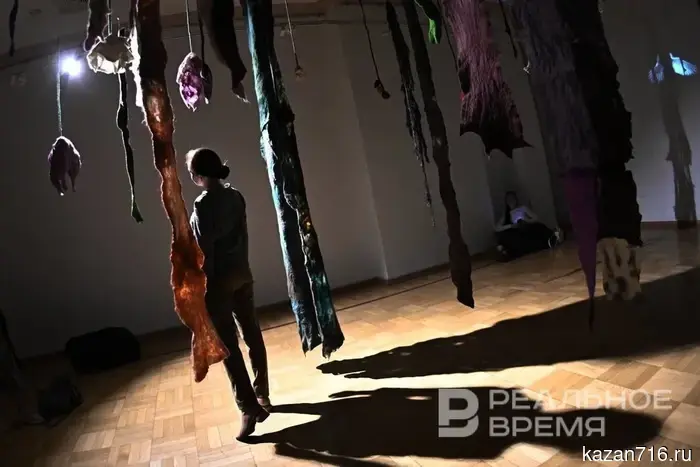
"The 'Khazine' gave space to artists and words."
Tukayev Exhibition from the State Museum of Fine Arts of the Republic of Tatarstan: Classics and Our Contemporaries
Work by Shamil Shaidullin, part of a triptych. Photo: Dinara Fatykhova
The State Museum of Fine Arts of the Republic of Tatarstan has also joined the series of events dedicated to the 140th anniversary of the birth of Gabdulla Tukay: "The Word that Became a Symbol" has gathered, perhaps, some of the most famous works inspired by the creativity and fate of the poet, a kind of best of the best, during the viewing of which the enlightened viewer often catches flashbacks.
From Childhood to Shurale
The exhibition was prepared in collaboration with the Institute of Language and Literature, the Department of Manuscripts and Rare Books of the Scientific Library of Kazan Federal University, the Kazan Scientific Center of the Russian Academy of Sciences, and private collectors. Unlike exhibitions at the Literary Museum named after the poet and the National Museum, this one is based on the biography of the hero, with the exposition divided into four themes. "Fate and Calling" speaks of the early years. "Enlightenment" focuses on newspaper and magazine activities. A large block is dedicated to "Theater and Environment" and the poet's communication with Zaituna Mavlyudova, the official "love of the poet." The finale — fairy tales, Shurale, and Su anasy. Installation by Alfiya Ilyasova. Dinara Fatykhova / realnoevremya.ru
— This is not just an exhibition of fine arts, it is a deep immersion not only into the biography, but a new interpretation of his poems, in Tatar and Russian, showcasing his books published during his lifetime, — noted the director of the State Museum of Fine Arts of the Republic of Tatarstan, Rozaliya Nurgalieva, emphasizing that it was decided to show not many works, paying attention to the text.
She specifically highlighted the tapestry "Water Woman" by Galina Malikova:
— We don’t often exhibit it, look at this riot of colors! I remember how she created it, reading poems, fairy tales... I am very pleased that this project is essentially dramaturgy, a theater directed by our employees, Alina Sharafutdinova and Aigul Gatina. They honestly admitted to me that after preparing the exhibition, they realized: we simply did not know Tukay...
Tapestry by Galina Malikova. Dinara Fatykhova / realnoevremya.ru
Familiar and Unfamiliar
The exhibition tries to cover a significant period of creativity of artists inspired by Tukay, starting with illustrations by Baynazar Almenov. Despite the chronological principle, the exhibition seems even more interesting to view from the end, entering a dimly lit hall resembling a dense forest. This spatial composition (felt, wool, artificial dyes, as well as animation of Rustem Kildibekov's graphics) is by Alfiya Ilyasova.
Afterward, one can explore familiar illustrations for "Shurale" and "Hay Market" — Almenov, Faizrahman Aminov, Baki Urmanche. And then rush to the diverse, previously unseen works online or in albums, such as Shamil Shaidullin's triptych "Requiem for the Soul. Dedication to G. Tukay" with the huge "Gaze from Eternity," as if from the book graphics of the 90s, as if carved in stone painting. Or to the carved Shurale-kuraist by the great Ahsan Fathutdinov.
"Kisekbash" by Ilgizar Khasanov. Dinara Fatykhova / realnoevremya.ru
In short, there are many discoveries — like the huge Kisekbash by Ilgizar Khasanov. He is now better known as an author of installations, and in "Khazina" you can see his ironic Kisekbash, a giant head from the poet's poem.
Notably, in portrait works, one Tukay does not resemble another. Here is a work by Yefim Simbirin — some alien adult in Krylai. Or his portrait, but not for the centenary of Tukay, but for the 90th anniversary: no less tired, but seemingly even closer. Here is a completely different poet on the canvas of Viktor Fedorov, in the company of the "Sayar" troupe. Valery Skobeev unites the poet and another jubilarian Gabdulla Kariyev, with the director taking a leading position in the painting.
And is this photographic accuracy necessary — tells us a metal creation by Igor Bashmakov, uniting the Senno Bazaar Mosque, the "Bulgar" numbers, and the Usmanov courtyard (altogether — the corner of Moscow and Paris Commune) into a microplanet of the Old Tatar settlement.
A bit of classical book illustration. Dinara Fatykhova / realnoevremya.ru
Zaituna Speaks
At the same time, in addition to graphics, painting, and sculpture, the exhibition features multimedia (voice — actress Rezeda Salakhova, who has managed to establish herself as a narrator in her native Tinchurinsky Theater in the play "Tukay. Orchestra. Artificial Intelligence"). In particular, viewers listen to her while looking in the mirror: Salakhova transforms into Zaituna and recounts meetings with Tukay (based on the 2006 book by Aznakayev writer Mirsay Garif "Eternal Love"). This is also myth-making: there were five meetings, the last one occurred in 1908, Zaituna was leaving for Chistopol, Tukay confessed that the white spot on his left eye was from smallpox, and promised to give an address. But he did not keep his word. As if the words about the relationship between two people are more vividly expressed in "From the Lyrics of G. Tukay" by the same Kildibekov: depicted are two immersed in their own solitude.
And this is the realism of Usman Abdulov. Dinara Fatykhova / realnoevremya.ru
The creative atmosphere is enhanced by quotes from the poet, particularly from the story "Ismendä qalğanlar" ("What I Remember About Myself"), which Tukay scholars solemnly recommend not to perceive as an accurate autobiography — it is a work of art, just like the works of the artists. But along with the text about how young Gabdulla was brought to the Hay Market to find him new guardians, Usman Abdulov's painting describing this textbook event seems to work even sharper. On the other hand, perhaps someone may not appreciate this scale, they can choose the graphics of Vyacheslav Ilyin, who creates fairy-tale worlds from urban and rural landscapes.
— Tukay is a collective image of a hero who, cutting through times, stages, epochs, and centuries, spaces, has come to us, he is with us today, — transitioned to elevated language academician Indus Tagirov. — There are names that are symbols of patience, talent, there are names-prayers. Tukay is one of them. A rare image, a rare nature, before whose name we stand at the sacrificial altar, we pray and ask: Tukay, help.
Radif Kashapov
Другие Новости Казани (Казань716)
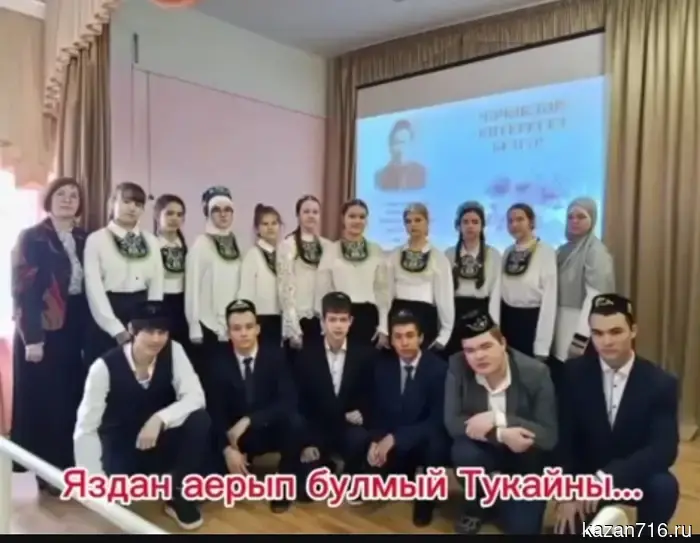 Spring and Tukai. The Tatar gymnasium in the Buinsky district celebrated the 140th anniversary of the great poet.
April 26 is the day when the world celebrates the 140th anniversary of the birth of the great Tatar poet Gabdulla Tukay. 22.04.2026. Newspaper Znamya. Republic of Tatarstan. Buinsk.
Spring and Tukai. The Tatar gymnasium in the Buinsky district celebrated the 140th anniversary of the great poet.
April 26 is the day when the world celebrates the 140th anniversary of the birth of the great Tatar poet Gabdulla Tukay. 22.04.2026. Newspaper Znamya. Republic of Tatarstan. Buinsk.
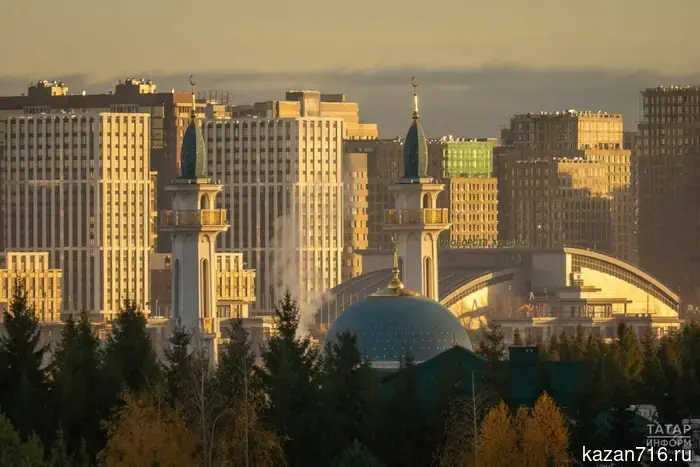 Kazan won the "Service" award for its strategy of interethnic unity.
Kazan took first place in the All-Russian municipal award "Service". 21.04.2026. IA Tatar-inform. Republic of Tatarstan. Kazan.
Kazan won the "Service" award for its strategy of interethnic unity.
Kazan took first place in the All-Russian municipal award "Service". 21.04.2026. IA Tatar-inform. Republic of Tatarstan. Kazan.
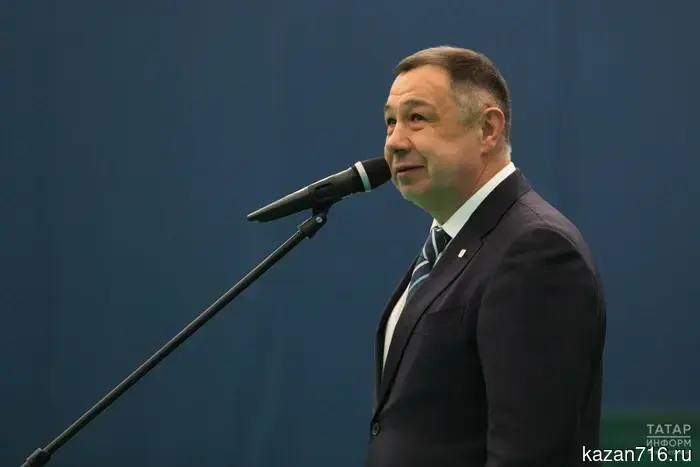 Vladimir Putin awarded Raisa Minnikhanova the Order of Friendship.
President of Russia Vladimir Putin awarded the head of the Sabinsky District of Tatarstan, Raisa Minnikhanova, the Order of Friendship. 22.04.2026. IA Tatar-inform. Republic of Tatarstan. Kazan.
Vladimir Putin awarded Raisa Minnikhanova the Order of Friendship.
President of Russia Vladimir Putin awarded the head of the Sabinsky District of Tatarstan, Raisa Minnikhanova, the Order of Friendship. 22.04.2026. IA Tatar-inform. Republic of Tatarstan. Kazan.
 Minnikhanov congratulated "Dynamo-Ak Bars" and "Ak Bars-Dynamo" on their success in the Russian Super Cup.
The head of Tatarstan, Rustam Minnikhanov, sent a congratulatory telegram to the teams of the field hockey clubs "Dynamo-Ak Bars" and "Ak Bars-Dynamo," as well as to their coaches and leaders of the sports and financial organizations of the republic. 21.04.2026. IA Tatar-inform. Republic of Tatarstan. Kazan.
Minnikhanov congratulated "Dynamo-Ak Bars" and "Ak Bars-Dynamo" on their success in the Russian Super Cup.
The head of Tatarstan, Rustam Minnikhanov, sent a congratulatory telegram to the teams of the field hockey clubs "Dynamo-Ak Bars" and "Ak Bars-Dynamo," as well as to their coaches and leaders of the sports and financial organizations of the republic. 21.04.2026. IA Tatar-inform. Republic of Tatarstan. Kazan.
 Vladimir Putin awarded Raisa Minnikhanova the Order of Friendship.
President of Russia Vladimir Putin awarded the head of the Sabinsky District of Tatarstan, Raisa Minnikhanova, the Order of Friendship. 22.04.2026. IA Tatar-inform. Republic of Tatarstan. Kazan.
Moscow's "Dynamo" defeated Kazan's "Zenit" away in the opening match of the final series.
The first match of the final series of the playoff of the Russian volleyball championship took place in Kazan. 22.04.2026. Kazan Vedomosti. Republic of Tatarstan. Kazan.
Vladimir Putin awarded Raisa Minnikhanova the Order of Friendship.
President of Russia Vladimir Putin awarded the head of the Sabinsky District of Tatarstan, Raisa Minnikhanova, the Order of Friendship. 22.04.2026. IA Tatar-inform. Republic of Tatarstan. Kazan.
Moscow's "Dynamo" defeated Kazan's "Zenit" away in the opening match of the final series.
The first match of the final series of the playoff of the Russian volleyball championship took place in Kazan. 22.04.2026. Kazan Vedomosti. Republic of Tatarstan. Kazan.
"The 'Khazine' gave space to artists and words."
Tukayev Exhibition from the State Museum of Fine Arts of the Republic of Tatarstan: Classics and Our Contemporaries Work by Shamil Shaidullin, part of a triptych. 04.22.2026. Real time. Republic of Tatarstan. Kazan.