
Sculptures from Burkina Faso were brought to the GSI.
Bronze elegance is showcased within the framework of the forum "Russia — Islamic World: KazanForum 2026." The exhibition was proposed to be brought to Russia by President Captain Ibrahim Traore. Photo: Radif Kashapov.
The exhibition "The Land of Honest People. Traditional Sculpture of Burkina Faso" opened at the Gallery of Contemporary Art. Official events will follow later, during the days of the forum "Russia — Islamic World: KazanForum 2026." For now, the GSI has shown journalists and bloggers what has arrived from the distant African country.
"Imitate the dance of others — do not follow the sins of others."
The exhibition begins before entering the hall, with quotations of local proverbs, such as "Imitate the dance of others — do not follow the sins of others" (this is the Mossi people), "Camels do not laugh at each other because of their humps" (the Fulani people). The exhibition features 34 African sculptors, with the earliest works created at the beginning of this century. As the curator of the exhibition Anna Ilyina explained, the idea belongs to the President of Burkina Faso, Captain Ibrahim Traore:
— He came to Russia a year ago at the invitation of the President of the Russian Federation Vladimir Vladimirovich Putin to participate in the Victory Day celebrations, — the curator said. — At this meeting, President Traore proposed to hold such an exhibition of Burkinabe bronze art in Russia, as bronze is one of the hallmarks of the country not only in Africa but also worldwide.
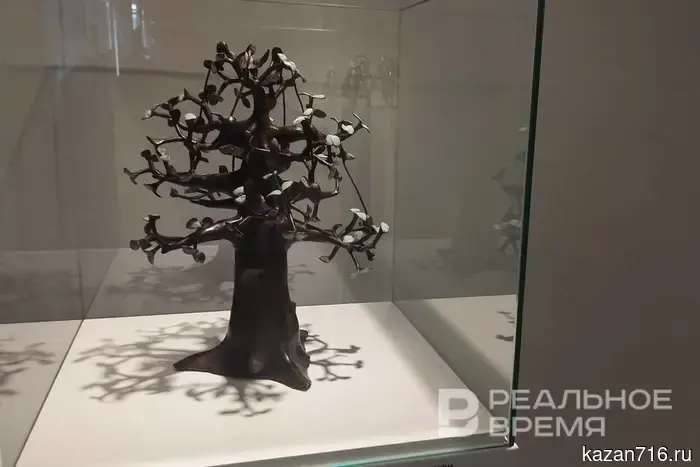
Bronze baobab. Radif Kashapov / realnoevremya.ru
As a result, just six months later, a collection of sixty sculptures arrived in Russia, initially in Novosibirsk, where the exhibition "Majesty in Bronze. Traditional Sculpture of Burkina Faso" opened, running from November to February. The organization was assisted by the Ministry of Industry, Trade, and Crafts of Burkina Faso, the international public organization "Center for People's Diplomacy," and Novosibirsk State Duma deputy Dmitry Saveliev.
Afterward, the organizers decided it would be logical to show the exhibition in other cities. Thus, it made its way to Kazan, where it will run until June. The exhibition is part of the program of the economic forum "Russia — Islamic World: KazanForum 2026," which will take place from May 12 to 17. The organizers remind that more than 60% of the population of Burkina Faso profess Islam. About a quarter of the population are Christians. There are also many people adhering to traditional African beliefs.
Princess Yennega. Radif Kashapov / realnoevremya.ru
Burkina Faso wants to be friends with Tatarstan.
Until 1984, Burkina Faso was a colony and then a republic called Upper Volta. "The Land of Honest People" is the translation of the name from the Moore and Dioula languages (burkiná — "straight, honest," fasо́ — "homeland"). It received its current name after another military coup. The last such event occurred on September 30, 2022, when the acting interim president Damiba (who had been in power since January) was ousted, and the mentioned Captain Ibrahim Traore became the leader.
In the winter of 2024, Kazan was visited by attachés from Congo and Burkina Faso — and they stated that they were ready to be friends with Tatarstan. The attaché from the land of honest people, Sawadogo Timbiéta, spoke in Russian without a translator and mentioned that Mali, Burkina Faso, and Niger had formed a military-political alliance oriented towards Russia.
By the way, in April of last year, an attempt at a coup was thwarted.
The economy is primarily agricultural: millet, sorghum, corn, cotton, and livestock. There are also gold mining activities. Desertification is a problem.
Women of Africa. Radif Kashapov / realnoevremya.ru
How and what is created in bronze
Bronze is indeed one of the symbols of local art; sculptors have been working with it since about the 15th century: first, a wax model is covered with clay and fired to allow the melted wax to flow out. Then, the mold is filled with bronze, and afterward, it is broken.
Ilyina notes that half of all the sculptures on display are female:
— African women are very beautiful; they are very stately. They have excellent posture from childhood, — said the curator, noting that representatives from the continent's countries will come to Kazan for the forum "Russia — Islamic World."
At the exhibition, women are depicted raising children, grinding millet, carrying water... In addition to sculpture, the GSI features household items, photographs, and a film about the country's history. Two lectures are planned — one on the art of Burkina Faso and another on tropical Africa as a whole.
Each sculpture is accompanied by an explanation, allowing visitors to study the exhibition independently, discovering, for example, that "Free Africa" by Ouedraogo Salif, a bird with wings shaped like a map of Africa, "reminds us that the future of the continent is built by its peoples, and freedom is not only independence but also the ability to dream, learn, and create."
And "Social Cohesion" by Ilbudo Saiuba depicts an egg from which three figures emerge, supporting the map of Burkina Faso. Several sculptures are dedicated to the baobab as a symbol of resilience, memory, and accumulated experience. An impressive image is Princess Yennega, the daughter of the king of the Dagombas. Once, she met a hunter named Riale in the savanna, thus the Mossi lineage (which constitutes half of Burkina Faso's population) was born.
This couple travels. Radif Kashapov / realnoevremya.ru
Another interesting part features figures of griots, musician-historian-advisors of West Africa, playing instruments like the balafon (something resembling a xylophone) and the kora (something like a violin). Conditional exoticism beautifully coexists with familiar modernity, such as the sculpture "Traveling Couple" by Marino Saidou — people in urban attire with bags, whose figures are either half full or half empty.
What truly unites all these works is their extraordinary elegance. The curator emphasizes that the exhibition genuinely reflects the real life of Burkina Faso.
— If you come to this country, you will see such sculptures everywhere — in hotels, in ministries, in markets, — notes Ilyina. — Of course, ordinary people also use bronze items, but ritual ones — they have amulets, special figurines. However, ordinary tourists are not allowed to such rituals. If you see something like that somewhere — it is a fabrication for tourists. It is indeed difficult to witness a genuine ritual. The themes and images used by sculptors depict the life and values that are important in this country, for this people.
Radif Kashapov
Другие Новости Казани (Казань716)
 Sculptures from Burkina Faso have been brought to the GSI.
Bronze elegance is showcased at the forum "Russia - Islamic World: KazanForum 2026.
The exhibition was proposed to be brought to Russia by President Captain Ibrahim Traore. 06.05.2026. Real time. Republic of Tatarstan. Kazan.
Krempton: The primaries will determine whether the post-Trump era has begun.
Photo: Official website of the President of the Russian Federation kremlin.ru
May 5 – IA SM.News. 05.05.2026. Kazan.Sm.News. Republic of Tatarstan. Kazan.
Crampton: The primaries will determine whether the post-Trump era has begun.
Photo: Official website of the President of the Russian Federation kremlin.ru
May 5 – IA SM.News. 05.05.2026. Kazan.Sm.News. Republic of Tatarstan. Kazan.
Sculptures from Burkina Faso have been brought to the GSI.
Bronze elegance is showcased at the forum "Russia - Islamic World: KazanForum 2026.
The exhibition was proposed to be brought to Russia by President Captain Ibrahim Traore. 06.05.2026. Real time. Republic of Tatarstan. Kazan.
Krempton: The primaries will determine whether the post-Trump era has begun.
Photo: Official website of the President of the Russian Federation kremlin.ru
May 5 – IA SM.News. 05.05.2026. Kazan.Sm.News. Republic of Tatarstan. Kazan.
Crampton: The primaries will determine whether the post-Trump era has begun.
Photo: Official website of the President of the Russian Federation kremlin.ru
May 5 – IA SM.News. 05.05.2026. Kazan.Sm.News. Republic of Tatarstan. Kazan.
 Sculptures from Burkina Faso have been brought to the GSI.
Bronze elegance is showcased at the forum "Russia - Islamic World: KazanForum 2026.
The exhibition was proposed to be brought to Russia by President Captain Ibrahim Traore. 06.05.2026. Real time. Republic of Tatarstan. Kazan.
Sculptures from Burkina Faso have been brought to the GSI.
Bronze elegance is showcased at the forum "Russia - Islamic World: KazanForum 2026.
The exhibition was proposed to be brought to Russia by President Captain Ibrahim Traore. 06.05.2026. Real time. Republic of Tatarstan. Kazan.
Sculptures from Burkina Faso were brought to the GSI.
The bronze elegance is showcased within the framework of the forum "Russia - Islamic World: KazanForum 2026. The exhibition was proposed to be brought to Russia by President Captain Ibrahim Traore. 06.05.2026. Real time. Republic of Tatarstan. Kazan.