
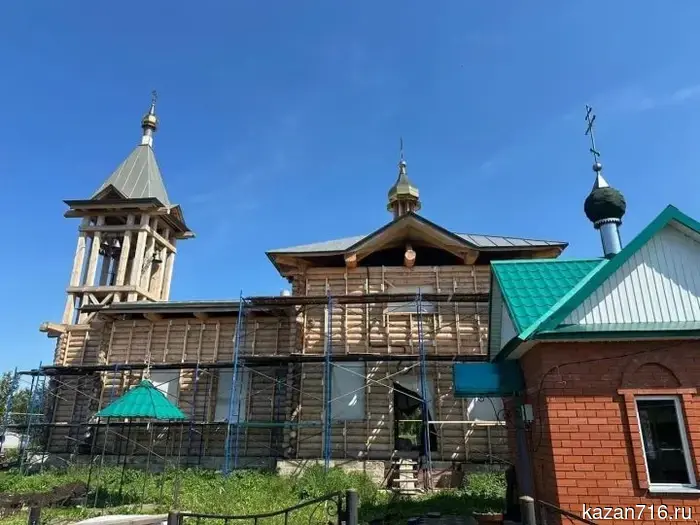
The Light of Upper Bagration: The Trinity Church has reopened its doors to parishioners.
The temple, built in the 19th century, survived a fire, years of neglect, and Soviet hardships, but was preserved thanks to the faith and concern of local residents. On June 1, 2026, Metropolitan Kirill consecrated the renovated shrine, returning the village its spiritual center and historical memory.
On June 1, 2026, early in the morning, the museum team gathered and set off for the village of Verkhny Bagryazh. This day was eagerly awaited for the opening of the revived Church of the Life-Giving Trinity, the arrival of Metropolitan Kirill, and other esteemed guests. We immediately got to work: we began to set up exhibits and collect displays. Glancing into the local House of Culture, we retrieved items related to Olympic champion Fyodor Simashev. My attention was drawn to a rolled-up sheet of thick paper. Unrolling it, we were astonished: before us was a map of Verkhny Bagryazh from 1888, depicting the church under construction.
That day, the village literally came to life: there hadn't been so many cars here in a long time. Residents from nearby villages, as well as those who had once left Verkhny Bagryazh, flocked here from all sides, for the revival of the church had been long anticipated. By a remarkable providence of God, the wooden church had survived much: it endured the devastating fire of 1896, withstood the years of Soviet power, and even its bell tower remained in place.
Descriptions of the church can be found in the books of Ayaz Gilyazov, who lived across the street. In his autobiographical story "Paths of Childhood," he writes: "My warmest, dearest memories are connected with this tiny point on the globe. The church opposite our garden, the school to our right, the spacious schoolyard – all these are dear to my heart, the heart of a restless boy, places that revealed to me some of the mysteries of existence...
The wooden church! To the wall opposite our windows, at the very top, a yellow-painted tin with the date "1840" was nailed. When we were little, the church, it turns out, celebrated its centenary. (Note: The church was insured against fire by the Salamandra society, and the plaque bore the year of the insurance society's establishment - 1846.) I vividly remember the tall cross, even higher than the ancient surrounding pines, gleaming on the dome, the interior adorned with gold and silver, the crosses hung on the walls, decorated with embroidered towels. In the 1930s, the communists of the village – Ozyin Mikail (Long-legged Mikhail) and some other men – sawed off the crosses from the domes and, mercilessly trampling and crushing the tin of the domes, threw them to the ground.
In the memoir novel "Let's Pray!", Ayaz Gilyazov writes: "A large garden, in the middle proudly rises the ancient wooden church. A little further away – massive oak crosses, blackthorn growing on the burial mounds. The boys have taken a liking to this secluded corner. The children swarming on the sports ground and schoolyard are afraid to approach the crosses, and even those who are older glance fearfully, preferring to keep a respectful distance."
According to the Ufa diocesan records, the parish in Bagryazh existed since the early 18th century. "In 1729, there were nine Christian settlements in the vicinity of the suburb of Zainsk: Sarsaz, Nalimy, Sredny Bagryazh, Verkhny Bagryazh, Theodorova 1st, Ursaeva, Theodorova 2nd, Ivanayeva, and Yelantova. It should be assumed that all the inhabitants of these settlements were foreigners, namely baptized Tatars. It is impossible to determine exactly when and from where they migrated here. It is likely that the appearance of these settlements can be attributed to the middle or, at least, the end of the 17th century. This is evident from the fact that 1) the decree states that the petitioners have lived in the mentioned settlements "from ancient times," 2) the parish is attributed to the suburb of Zainsk, 3) they encounter obstacles in satisfying their religious needs due to forests and mud, 4) they organized proper rural societies – with a hundredman, elected officials, and a foreman, 5) they heard of the Emperor's mercy towards the newly baptized, 6) they suffered devastation from the Bashkirs and others. If the petitioners had not inhabited these settlements from ancient times – since the 17th century, they could not have experienced all that was said in such a short time, like 28 years of the 18th century. In the mentioned nine villages in 1729, there were about a hundred Christian households, but how many souls they had is not clear from the decree. Considering that in those old times our ancestors loved to live in large families – 20-40 people in a family, we can boldly assume that in a hundred households there were no less than 1000 – 1500 souls of both sexes.
With the funds of Elabuga merchant Ivan Grigorievich Stakheev, according to the project of Ufa diocesan architect Alexander Vladimirovich Perkits, a single-altar wooden church in the name of the Holy Life-Giving Trinity was built in 1887-1889. The iconostasis of this church, part of the church utensils, and the bells were donated by him. The Bagryazh church is made of wood, covered with iron. The timber for the construction of this church and the parish houses was provided free of charge from state lands at the request of His Grace.
During the inspection by His Grace Dionysius, Bishop of Ufa and Menzelinsk, in the report of 1889 on churches and parishes of the Menzelinsk district, the Bagryazh church in the name of the Holy Life-Giving Trinity was personally consecrated by the Lord on June 17, 1889, with the participation of the following individuals: Archpriest Vladimir Uvodsky of the city of Menzelinsk, Archpriest Stefan Nikitin, and the priests of the village of Burdov Boris Vasilyev, the village of Zainsk Ioann Mirolyubov, and Serapion Vasnetsov, and local Priest Joseph Pavlov. During the consecration of this church, there was a huge gathering of pilgrims from both Russians and foreigners, despite the heavy rain on the eve and on the very day of the church's consecration. Thank God, the parish of the Trinity church of the foreign village of Bagryazh can currently be considered a fully well-equipped parish; the clergy of this church is secured by a state salary of 400 rubles per year, endowed with 33 desyatinas of land, and receives bread and ready-made accommodations from the parishioners.
After the fire that occurred in the church building on June 16, 1896, the church was consecrated a second time on March 5, 1897. The names of the priests Joseph Pavlov and his successor Simeon Melnikov are known. From 1893 to 1917, the priest, later archpriest Pavel Abramovich Selsky, served in the church. The Church of the Life-Giving Trinity was closed in 1931. All the domes were cut off, and the crosses were thrown down. The icons were taken away, but one fallen icon was preserved by a woman, whose family now lives in Tonguzino.
For some time, a club was located in the church building: a stage was in the altar part. In recent years, the building fell into oblivion, and everything inside crumbled. The Church of the Life-Giving Trinity in the Zainsk district of Tatarstan, in the village of Verkhny Bagryazh, was included in the register of cultural heritage sites. Over time, the church faded, the life of wood is not long-lasting. Why did the RT Committee for the Protection of Cultural Heritage take on this? All because of the activity of the residents, says Ivan Nikolaevich Gushchin. People wrote letters in the Kryashen language: "Save our church."
The news that the ancient church in Verkhny Bagryazh would be restored appeared in February 2022. At that time, part of its roof had already collapsed. The restoration took place as part of the federal project "Let's Preserve Together" under the control of the Republican Committee for the Protection of Cultural Heritage.
In 2023, the State Budgetary Institution "Center for Cultural Heritage of Tatarstan" and the LLC "United Construction Company" developed scientific and project documentation funded by the state program "Cultural Development of the Republic of Tatarstan," which received a positive conclusion from the state historical and cultural examination and approval from the Committee. An engineering and technical survey revealed a physical wear of the building at 60%. Since April 2023, emergency and restoration work has begun.
Thanks to charitable funds from the NGO "TUGAN IL" emergency and restoration work was carried out, and the JSC "Network Company" helped with the manufacture and installation of the church's fencing. The cross made of titanium nitride was crafted by masters from the Leningrad region, and the bells were cast in Yaroslavl. The second tier of the church was made not from logs but as
Другие Новости Казани (Казань716)
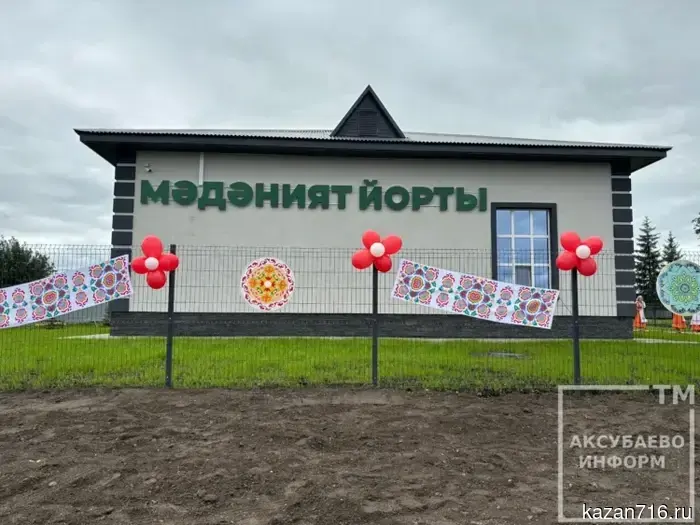 In the village of Novoe Demkino, a renovated House of Culture has opened after a major renovation.
In the village of Novoe Demkino, a ceremonial opening of the rural House of Culture took place after a major renovation. 29.06.2026. GTRK Tatarstan. Republic of Tatarstan. Kazan.
In the village of Novoe Demkino, a renovated House of Culture has opened after a major renovation.
In the village of Novoe Demkino, a ceremonial opening of the rural House of Culture took place after a major renovation. 29.06.2026. GTRK Tatarstan. Republic of Tatarstan. Kazan.
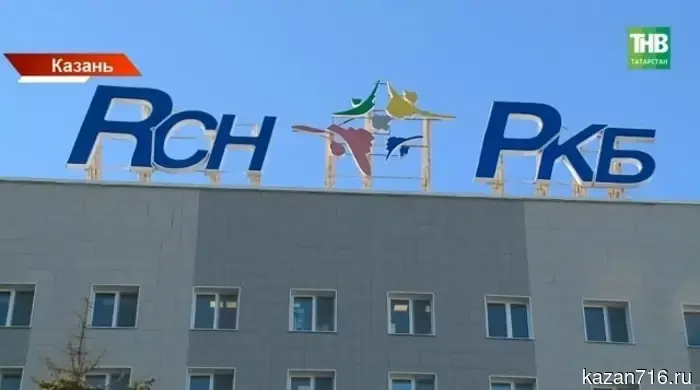 3D printing and surgery: doctors at RKB removed a tumor in the head the size of a ball
In Kazan, neurosurgeons at the Republican Clinical Hospital removed a tumor from the head measuring 8x9x6 cm from a 75-year-old woman. 29.06.2026. TRK Tatarstan-New Century. Republic of Tatarstan. Kazan.
3D printing and surgery: doctors at RKB removed a tumor in the head the size of a ball
In Kazan, neurosurgeons at the Republican Clinical Hospital removed a tumor from the head measuring 8x9x6 cm from a 75-year-old woman. 29.06.2026. TRK Tatarstan-New Century. Republic of Tatarstan. Kazan.
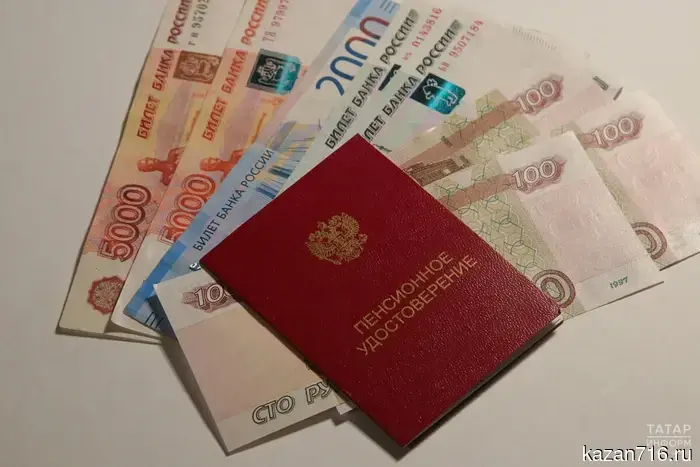 A State Duma deputy proposed to assign a pension supplement starting at 70 years old.
The head of the State Duma committee on labor, social policy, and veterans' affairs, Yaroslav Nilov, proposed to lower the age for assigning an increased fixed payment to the old-age insurance pension. 29.06.2026. IA Tatar-inform. Republic of Tatarstan. Kazan.
Almetyevsk is preparing to host the All-Russian jet ski tournament.
From July 17 to 20, the all-Russian aquabike competitions for the Cup of Russia will take place in the waters of the city reservoir. 29.06.2026. Almetyevsky District. Republic of Tatarstan. Almetyevsk.
How to become an exhibitor at the exhibition of equipment and technologies for the fuel and energy complex at REN?
The exhibition within the framework of the International Forum Russian Energy Week is a space where energy becomes tangible: here you can see new technologies, June 29, 2026. Sabinsky District. Republic of Tatarstan. Rich Saby.
A State Duma deputy proposed to assign a pension supplement starting at 70 years old.
The head of the State Duma committee on labor, social policy, and veterans' affairs, Yaroslav Nilov, proposed to lower the age for assigning an increased fixed payment to the old-age insurance pension. 29.06.2026. IA Tatar-inform. Republic of Tatarstan. Kazan.
Almetyevsk is preparing to host the All-Russian jet ski tournament.
From July 17 to 20, the all-Russian aquabike competitions for the Cup of Russia will take place in the waters of the city reservoir. 29.06.2026. Almetyevsky District. Republic of Tatarstan. Almetyevsk.
How to become an exhibitor at the exhibition of equipment and technologies for the fuel and energy complex at REN?
The exhibition within the framework of the International Forum Russian Energy Week is a space where energy becomes tangible: here you can see new technologies, June 29, 2026. Sabinsky District. Republic of Tatarstan. Rich Saby.
 All-Russian Youth Educational Forum "Rostov"
We invite you to participate in the All-Russian Youth Educational Forum "Rostov". 29.06.2026. Sabinsky District. Republic of Tatarstan. Bogatye Saby.
All-Russian Youth Educational Forum "Rostov"
We invite you to participate in the All-Russian Youth Educational Forum "Rostov". 29.06.2026. Sabinsky District. Republic of Tatarstan. Bogatye Saby.
The Light of Upper Bagration: The Trinity Church has reopened its doors to parishioners.
The temple, built in the 19th century, survived a fire, years of neglect, and the hardships of the Soviet era, but has been preserved thanks to the faith and concern of the local residents. 29.06.2026. News of Zainsk. Republic of Tatarstan. Zainsk.