"I believe, but I won't go to church": how the life of an Orthodox person is connected to the Church
The priest spoke about what the Church is, how it is structured, and what its significance is in the life of a Christian. "Tatar-inform" continues the series of video podcasts "Coffee with the Priest" and "Priest Against" on Orthodox topics. In the last episode, the priest talked about fashion. Today, the head of the missionary department of the Kazan diocese, priest Alexander Ermolov, discusses how the Church is organized in the podcast "Coffee with the Priest."
"It is unusual for us that drums are used in Orthodox churches in Africa." – Unfortunately, when people talk about the Church, they often imagine a building with a dome and a cross, although in reality, this is a temple, and the Church is an organization. After His Resurrection, Jesus Christ tells His disciples that He will send them the Holy Spirit and asks them to remain in expectation. The apostles unanimously stayed in Jerusalem, and on the day of Pentecost, that is, the fiftieth day after Easter, the Lord sends the Holy Spirit upon the apostles. Since then, we call this day the Day of the Holy Trinity, or the birthday of the Church. After the descent of the Holy Spirit, the apostles go to preach the Gospel throughout the world. Thus, the Church appears as a unique unity of all believers in Christ. Therefore, if we give a dogmatic answer to the question "What is the Church?", it will sound like "The Church is the unity of all believers in Christ." The head of the Church is the Lord Jesus Christ Himself. In the Church, there are laypeople, clergy, both living and deceased, as well as saints. All together, this constitutes the Church of Christ. From the very first day of its existence, the Church has been directed to all people, to all nations, and historically has always reached out to all people living on Earth. We see this same picture today: the Orthodox Church exists on all continents of our planet, in all territories, even the most remote. The Church as an organization is the unity of many Local Orthodox Churches. Among them are ancient ones, such as the Antiochian or Jerusalem Church. The existence of the Russian, Georgian, Japanese, Greek, and many other churches in the world shows that the word of God is directed to all humanity and that all people must hear it. The Church carries out its ministry, taking into account national and cultural characteristics. For example, a Greek priest looks quite different from a Russian priest. This is because each nation has its own cultural features, its own language and traditions, and this does not destroy but rather emphasizes the unity of the Church of Christ. When we talk about some national characteristics of Local Orthodox Churches, it is very important to understand that first and foremost, we are all united; we all profess the same faith, regardless of the language in which we pray and conduct services in churches. We are all united, regardless of which continent we are on. What differences are there among us? Besides linguistic and cultural differences, there may be some external things that differ. For example, the vestments of priests – everyone easily recognizes the beautiful Greek vestments, as they stand out clearly among all others. We see how Orthodox Arabs rejoice during the Easter celebration – they always run around the Church of the Holy Sepulchre very emotionally. In Orthodoxy on the African continent, everything is always very emotional; it is unusual for us that they use drums in churches.
"To partake, to confess the true faith is impossible if you are outside the church fence." – People often ask why the Church is needed at all. The Lord Himself says that He will build His Church, addressing the apostle Peter: "And I say to you: you are Peter, and on this rock, I will build My Church, and the gates of hell shall not prevail against it." This is a direct indication from the Lord Himself. He tells Peter that He will give him the keys and the power to bind and loose. This means that the apostles and priests have the right to forgive the sins of the repentant and to determine church rules. The main task of the Church is to be the guardian of the truth. The Church performs the Divine Liturgy, administers sacraments, and is the primary means of uniting God and man so that a person can be in communion with God. Often people reason that God is in their soul and they do not need any external organization. But from the earliest times in Christian history, we know the words of Christian authors: "He who does not have the Church as his mother, does not have God as his father." From the very first centuries, people understood that without the Church, they cannot live; without it, they have no opportunity for salvation. This is the main task of the Church. It is clear that clergy engage in other activities: missionary, educational, charitable, and so on. But it is important to understand that essentially, the Church is given to us so that we can go to the temple, partake, and confess the true faith. And all this is impossible if you are outside the church fence.
With the words of the prayer "Symbol of Faith," we confess our faith in the One Holy, Catholic, and Apostolic Church. So it turns out – here are the four properties: unity, holiness, catholicity, and apostolicity. What does this mean? The unity of the Church means that it is one large unified mechanism throughout the world. The Holy Church is the holiness of the church organization, regardless of any personal shortcomings of each of its members. Catholicity indicates the main principle of the Church's life – the main issues are resolved by the conciliar mind. That is, the main body in our Church is the local council – the assembly of all bishops, all representatives of the clergy and laity. Apostolicity indicates that the Church arose as a result of the preaching of the holy apostles. And, of course, it also indicates that we preserve the faith according to the teachings of the holy apostles.
There is a tradition – the understanding of apostolic succession. There is a chain of ordinations from the very first centuries, from the holy apostles to our days. That is, when we talk about a modern bishop, his chain of ordinations goes back to the apostles themselves. Therefore, they are called the princes of the Church, and where there is no bishop, there cannot be a Church. Bishops are the guardians of the Church, the pillars of the Church, and without them, the Church is impossible.
"The main task of the priest is to perform the service." The head of the Church is the Lord Jesus Christ Himself, and in Local Churches, it is the Patriarch. If we talk about the Russian Orthodox Church, its head is the Most Holy Patriarch of Moscow and all Rus.
We have a church hierarchy: bishops, priests, deacons. This is the oldest Christian tradition, which is described in the Holy Scriptures. Bishops are ordained with the participation of two or three other bishops. Bishops ordain other priests. The priest performs services in churches and monasteries. Interestingly, the priest does not perform the service by himself, but in the name of his bishop. That is, the bishop has blessed him, appointed him to a specific church, and he performs this ministry in his parish in the name of his bishop.
There is also the ministry of deacons – this is the ministry of helpers; they assist during the service. As a rule, these are people with good vocal abilities; they can sing and read beautifully and are an adornment of the church service. We have already talked about this in one of our episodes.
The main task of the priest is to perform the service. It is clear that we do many other things. This includes mission work, educational work, and so on, but the main thing is the performance of services. This is precisely why priests are appointed. They perform the Divine Liturgy, hear confessions, and administer other sacraments. And here we must remember that the priestly ministry is not just the service of a teacher or some kind of mentor. No, it is precisely those gracious gifts, that charisma, which is given by the Lord Himself; this authority rests on every clergyman.
* * *
Leave your questions on the topic of Orthodoxy in the window below the text – Father Alexander will give detailed answers to them in the following episodes of the video podcasts "Coffee with the Priest" or "Priest Against" on the "Tatar-inform" website.
OTHER EPISODES #COFFEE WITH THE PRIEST AND #PRIEST AGAINST
Photo: © Vladimir Vasilyev / "Tatar-inform"
Другие Новости Казани (Казань716)
 The accident happened: a step-by-step guide on how not to harm yourself
A traffic accident can happen to anyone. In a stressful situation, it is easy to get confused and make a mistake, 02.08.2026. News of Zainsk. Republic of Tatarstan. Zainsk.
The Prime Minister of Armenia, Nikol Pashinyan, has resigned.
The government of Armenia resigned on the day of the first session of the newly elected parliament, reported the country's Prime Minister Nikol Pashinyan. 02.08.2026. Business Online. Republic of Tatarstan. Kazan.
Traffic on the Siberian Highway in Kazan will be restricted from September 12 to 29.
Traffic on the Siberian Highway in Kazan will be restricted from September 12 to 29 due to gas pipeline construction. 02.08.2026. TRK Tatarstan-New Century. Republic of Tatarstan. Kazan.
Sardaryan: The migration crisis in Spanish Ceuta benefits Morocco, Israel, and the USA.
Photo: IA SM-News
August 2 – IA SM.News. The migration breakthrough at the Spanish border is not a spontaneous event and is clearly coordinated at the highest level. 02.08.2026. Kazan.Sm.News. Republic of Tatarstan. Kazan.
The accident happened: a step-by-step guide on how not to harm yourself
A traffic accident can happen to anyone. In a stressful situation, it is easy to get confused and make a mistake, 02.08.2026. News of Zainsk. Republic of Tatarstan. Zainsk.
The Prime Minister of Armenia, Nikol Pashinyan, has resigned.
The government of Armenia resigned on the day of the first session of the newly elected parliament, reported the country's Prime Minister Nikol Pashinyan. 02.08.2026. Business Online. Republic of Tatarstan. Kazan.
Traffic on the Siberian Highway in Kazan will be restricted from September 12 to 29.
Traffic on the Siberian Highway in Kazan will be restricted from September 12 to 29 due to gas pipeline construction. 02.08.2026. TRK Tatarstan-New Century. Republic of Tatarstan. Kazan.
Sardaryan: The migration crisis in Spanish Ceuta benefits Morocco, Israel, and the USA.
Photo: IA SM-News
August 2 – IA SM.News. The migration breakthrough at the Spanish border is not a spontaneous event and is clearly coordinated at the highest level. 02.08.2026. Kazan.Sm.News. Republic of Tatarstan. Kazan.
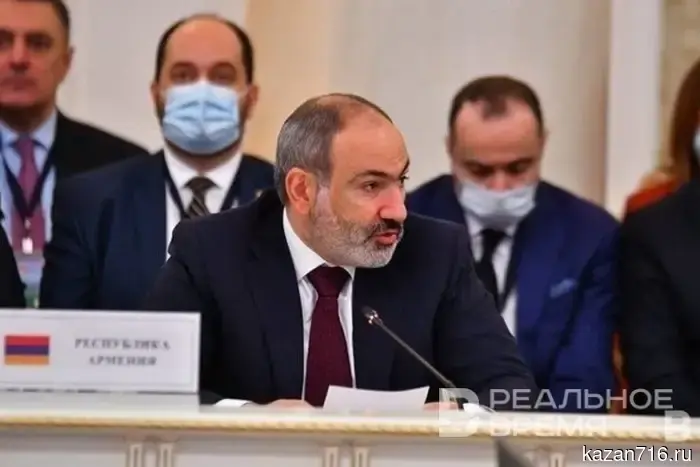 The President of Armenia has reappointed Nikol Pashinyan as Prime Minister.
The appointment became a formality after Pashinyan's party won the extraordinary parliamentary elections.
Photo: 02.08.2026. Real Time. Republic of Tatarstan. Kazan.
Drones attacked a Wildberries warehouse in the Samara region — a fire broke out at the site.
The Wildberries warehouse in the Samara region was attacked by drones. This was reported by the governor of the region, Vyacheslav Fedorishchev. 02.08.2026. Online Business. Republic of Tatarstan. Kazan.
The President of Armenia has reappointed Nikol Pashinyan as Prime Minister.
The appointment became a formality after Pashinyan's party won the extraordinary parliamentary elections.
Photo: 02.08.2026. Real Time. Republic of Tatarstan. Kazan.
Drones attacked a Wildberries warehouse in the Samara region — a fire broke out at the site.
The Wildberries warehouse in the Samara region was attacked by drones. This was reported by the governor of the region, Vyacheslav Fedorishchev. 02.08.2026. Online Business. Republic of Tatarstan. Kazan.
"I believe, but I won't go to church": how the life of an Orthodox person is connected to the Church
The priest talked about what the Church is, how it is structured, and what its significance is in the life of a Christian. "Tatar-inform" continues the series of video podcasts "Coffee with the Priest" and "The Priest Against" on Orthodox topics. 02.08.2026. IA Tatar-inform. Republic of Tatarstan. Kazan.