
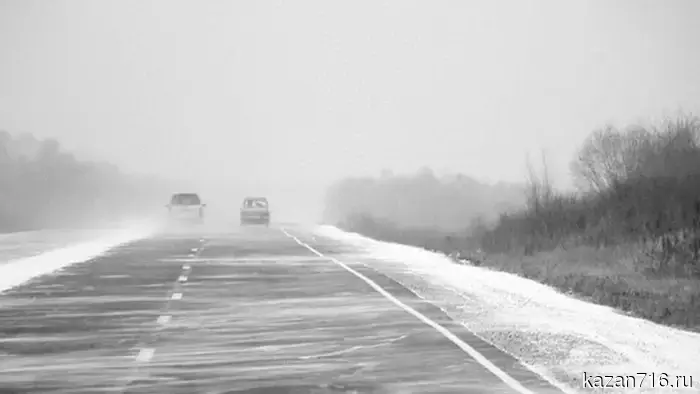
Emergency warning for 07.03.2026.
Dear citizens! The Federal State Budgetary Institution "Administration for Hydrometeorology and Environmental Monitoring of the Republic of Tatarstan" has issued: Consultation - warning about the intensity of meteorological phenomena from 2 PM to 6 PM on March 7, 2026. In the afternoon and evening of March 7, 2026, blizzards are expected in some areas of the Republic of Tatarstan and in Kazan, with visibility deteriorating to 1-2 km and strong winds with gusts of 15-17 m/s.
The Main Directorate of the Ministry of Emergency Situations of Russia for the Republic of Tatarstan informs: How to act during a strong blizzard. Only in exceptional cases should you leave buildings. It is prohibited to go out alone. Inform family members or neighbors where you are going and when you will return. In a car, you can only move on major roads and highways. When exiting the vehicle, do not stray from it out of sight. If you stop on the road, signal for help with intermittent honks, raise the hood, or hang a bright cloth on the antenna, and wait for assistance in the vehicle. You can leave the engine running, slightly opening the window for ventilation and to prevent carbon monoxide poisoning. If you lose orientation while walking outside populated areas, enter the first house you find, clarify your location, and, if possible, wait for the blizzard to end. If you are losing strength, seek shelter and stay there. Be cautious and careful when interacting with unfamiliar people, as the number of thefts from cars, apartments, and offices sharply increases during natural disasters.
If you find yourself blocked in a building due to heavy snowdrifts, cautiously and without panic, check if there is a way to dig yourself out (using available tools and improvised means). Inform the emergency management office or the local administration about the nature of the snowdrifts and the possibility of clearing them yourself. If you cannot clear the snowdrift on your own, try to establish contact with rescue services. Turn on a radio receiver (television) and follow the instructions of local authorities. Take measures to keep warm and conserve food supplies.
To drivers: Drivers, especially those planning long-distance trips, should pay special attention to the technical condition of their vehicles. Check the weather forecast for the next day or two, depending on the time of travel. Before a long trip in cold weather, take care of the vehicle's insulation in advance. Before the trip, check the engine and battery, stock up on fuel, and fill in good antifreeze. It is important not to refuel at unverified gas stations, as poor-quality fuel can cause problems. Be sure to stock up on warm clothing and food, and don’t forget a charger for your mobile phone.
Check for a pump, tow rope, wheel wrench, and jack. Before departure, check for a pump, tow rope, wheel wrench, and jack. It’s also a good idea to throw a set of jumper cables in the trunk. If resources allow, it’s advisable to have a jump starter based on a compact lithium battery.
Emergency kit: The emergency kit should contain: a mobile phone charger and spare battery, warm clothing and blankets, a brush for removing snow and ice from the windshield, a small shovel to free the wheels from snow if necessary; a flashlight and a set of batteries for it, a first aid kit, food and drink, an axe and a folding saw, a pack of "dry fuel," a lighter, a mini-stove, and a pot.
Inform about the updated route and estimated time of arrival: Before the trip, inform family members, neighbors, and friends about the updated route and estimated return time. If trouble occurs on the road, use modern means of communication - this will significantly speed up the response time of rescue services. When contacting rescuers, specify your location, distinctive features of the area, the number of people in the vehicle, their ages, whether there are sick individuals or children, and be sure to provide your and your relatives' contact phone numbers. Take measures to conserve battery charge.
If a breakdown occurs on the highway: Place warning signs in front of and behind the vehicle; this can be a cut tree or any protruding items. If the car is running, slightly open the window for ventilation and to prevent carbon monoxide poisoning. For long stops or overnight stays, position the vehicle against the wind so that exhaust gases do not enter the slightly open windows of the cabin and interior. For your own safety, periodically check the wind direction. It is also important to ensure that the exhaust pipe is not blocked by ice or snow. If the vehicle breaks down, do not panic, dial the emergency services number "101," report your problem, and provide your location coordinates. Take measures to keep warm and conserve food supplies. Try to stock up on firewood; if unavailable, you can burn combustible materials - there is usually quite a bit of that.
To drivers:
1. When driving under these conditions, avoid unnecessary lane changes, overtaking, and passing;
2. Pay attention to the technical condition of the vehicle, especially the braking system and tire condition;
3. Avoid sudden braking; if you need to stop, reduce speed gradually;
4. Press the brake pedal several times to signal drivers of vehicles behind you;
5. All lights should be in working order;
6. Drive at a speed that ensures safety in busy traffic areas, near schools, at intersections and bridges, as well as on turns and descents.
To pedestrians:
1. Be extremely careful when crossing streets and roads;
2. Cross the street only at designated pedestrian crossings, remembering that due to poor visibility and slippery road surfaces, drivers need more time to stop their vehicles;
3. Use, if possible, only overpasses or underpasses to cross the roadway;
4. Do not run across the road in front of moving vehicles;
5. Move only against the flow of traffic;
6. Use a high-visibility vest or attach reflective elements to your clothing.
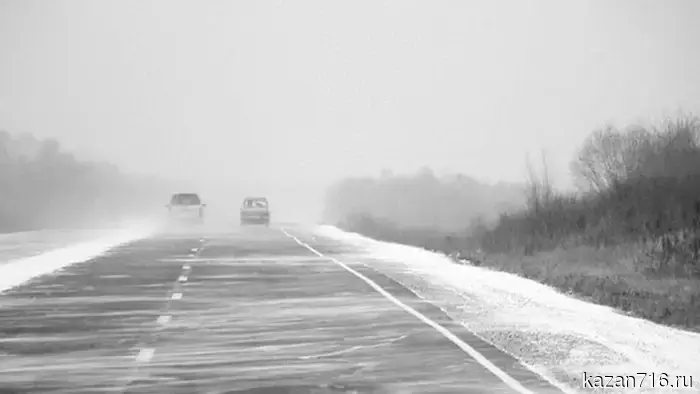
Другие Новости Казани (Казань716)
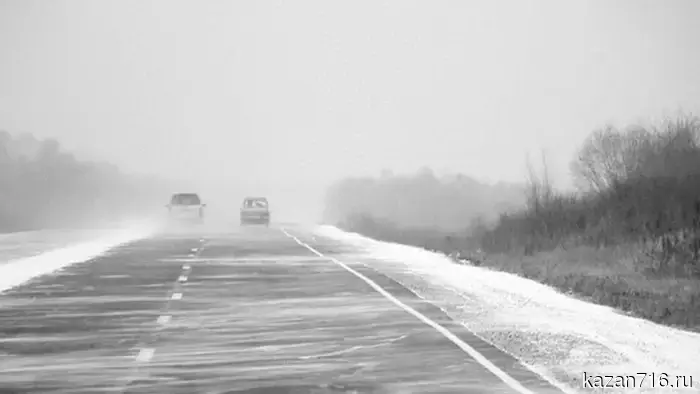 Emergency warning for March 7, 2026.
Dear citizens! From the Federal State Budgetary Institution "Administration for Hydrometeorology and Environmental Monitoring of the Republic of Tatarstan" received:
Consultation - warning about the intensity of meteorological phenomena
from 2 PM to 6 PM on March 6, 2026. Bavlinsky Municipal District. Republic of Tatarstan. Bavly.
A KAMAZ caught fire on the Kirov Dam, traffic is partially blocked.
In Kazan, a KAMAZ caught fire on Kirov Dam, and traffic on the roadway is partially blocked. 07.03.2026. IA Tatar-inform. Republic of Tatarstan. Kazan.
Agricultural fairs in Tatarstan will resume operations on March 14.
In the Republic of Tatarstan, the annual spring agricultural fairs will resume on March 14. 07.03.2026. IA Tatar-inform. Republic of Tatarstan. Kazan.
A KAMAZ caught fire on the Kirov Dam, traffic is partially blocked.
In Kazan, a KAMAZ caught fire on the Kirov embankment, and traffic on the roadway is partially blocked. 07.03.2026. IA Tatar-inform. Republic of Tatarstan. Kazan.
Emergency warning for March 7, 2026.
Dear citizens! From the Federal State Budgetary Institution "Administration for Hydrometeorology and Environmental Monitoring of the Republic of Tatarstan" received:
Consultation - warning about the intensity of meteorological phenomena
from 2 PM to 6 PM on March 6, 2026. Bavlinsky Municipal District. Republic of Tatarstan. Bavly.
A KAMAZ caught fire on the Kirov Dam, traffic is partially blocked.
In Kazan, a KAMAZ caught fire on Kirov Dam, and traffic on the roadway is partially blocked. 07.03.2026. IA Tatar-inform. Republic of Tatarstan. Kazan.
Agricultural fairs in Tatarstan will resume operations on March 14.
In the Republic of Tatarstan, the annual spring agricultural fairs will resume on March 14. 07.03.2026. IA Tatar-inform. Republic of Tatarstan. Kazan.
A KAMAZ caught fire on the Kirov Dam, traffic is partially blocked.
In Kazan, a KAMAZ caught fire on the Kirov embankment, and traffic on the roadway is partially blocked. 07.03.2026. IA Tatar-inform. Republic of Tatarstan. Kazan.
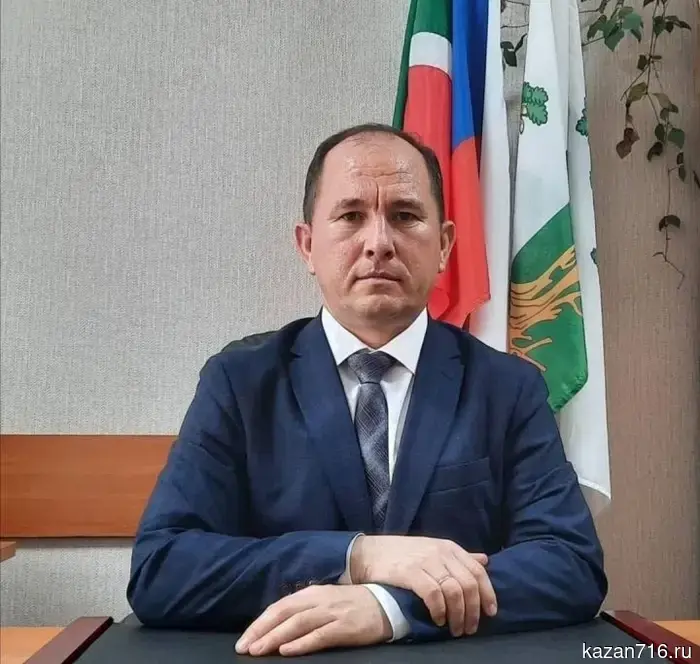 The head of the executive committee, the chairman of the Kaibitsky district traffic safety commission, calls for adherence to traffic rules.
Each of us almost daily becomes a participant in road traffic: either as a pedestrian or a driver. 07.03.2026. Kaibitsky Zori. Republic of Tatarstan. Bolshie Kaibitsy.
The head of the executive committee, the chairman of the Kaibitsky district traffic safety commission, calls for adherence to traffic rules.
Each of us almost daily becomes a participant in road traffic: either as a pedestrian or a driver. 07.03.2026. Kaibitsky Zori. Republic of Tatarstan. Bolshie Kaibitsy.
 Svischev: "The admission of youth teams is a step towards Russia's return to world sports."
The First Deputy Chairman of the State Duma Committee on Physical Culture and Sports, Dmitry Svishchev, called the decision to allow youth and junior teams from Russia to participate in international tournaments good news and expressed hope, 07.03.2026. IA Tatar-inform. Republic of Tatarstan. Kazan.
Svischev: "The admission of youth teams is a step towards Russia's return to world sports."
The First Deputy Chairman of the State Duma Committee on Physical Culture and Sports, Dmitry Svishchev, called the decision to allow youth and junior teams from Russia to participate in international tournaments good news and expressed hope, 07.03.2026. IA Tatar-inform. Republic of Tatarstan. Kazan.
Emergency warning for 07.03.2026.
Dear citizens! From the Federal State Budgetary Institution "Administration for Hydrometeorology and Environmental Monitoring of the Republic of Tatarstan" we received: Consultation - warning about the intensity of meteorological phenomena from 2 PM to 6 PM on March 6, 2026. Bavlinsky Municipal District. Republic of Tatarstan. Bavly.