
Lazarus Saturday and Vasily the Warm: traditions and signs for April 4th
April 4, 2026, is the day when Orthodox believers remember one of the greatest miracles, and our ancestors predicted the summer and harvest based on the weather. This year is special: Lazarus Saturday coincides with the feast day of Saint Basil, who was nicknamed the Warm in Russia. What can and cannot be done, what traditions our ancestors observed, and what unusual holidays are celebrated around the world today—read in our material.
Orthodox holiday: Lazarus Saturday
On April 4, 2026, Orthodox Christians celebrate Lazarus Saturday—the day preceding Palm Sunday and concluding the sixth week of Great Lent. This holiday is dedicated to the remembrance of the miracle of the resurrection of the righteous Lazarus, performed by Jesus Christ. According to the Gospel of John, Lazarus, a friend of Christ, lived in Bethany with his sisters Martha and Mary. When he fell gravely ill, the sisters sent for Jesus, but he did not hurry. He said, "This sickness is not unto death, but for the glory of God." By the time the Savior arrived in Bethany, Lazarus had already been dead and buried in a cave for four days. Jesus commanded that the stone be rolled away from the entrance to the tomb and, after praying, called out loudly, "Lazarus, come forth!" And the dead man came out alive, wrapped in burial cloths. This miracle astonished all who were present. The news of the resurrection quickly spread throughout the region, and when Jesus entered Jerusalem, the people welcomed him like a king, laying palm branches along the road. In memory of this event, Palm Sunday will be celebrated the next day, April 5. After his resurrection, Lazarus lived for another thirty years, becoming a bishop in Cyprus. His relics, possessing miraculous power, were discovered in the late 9th century in the city of Larnaca, where a church was built over his tomb. On Lazarus Saturday, special services are held in churches. Clergy wear bright vestments instead of mourning black, and during the evening service, they bless willow branches—a symbol of the upcoming Resurrection. On this day, a relaxation of the fast is permitted: one can eat fish roe, dishes with vegetable oil, and drink a little red wine mixed with water.
What can and should be done on Lazarus Saturday: attend church for the service or pray at home, perform good deeds and help those in need, read the Gospel of John about the resurrection of Lazarus, and bless willow in the church. What should be avoided: noisy entertainment and alcohol consumption, conflicts and judging others, heavy household chores—cleaning and laundry, overeating—moderation is important.
Traditions of the day: Basil the Warm
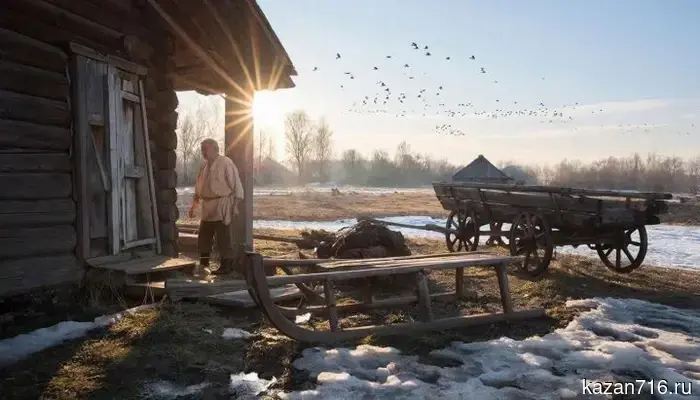
In the folk calendar, April 4 is Basil the Warm, also known as Basil the Sunflower or Basil the Greenhouse. In Russia, it was believed that from this day, spring warmth finally takes hold. No matter how harsh the winter was, it retreated by Basil. People said, "Basil has driven away winter." From this day, the sledding path was finally ruined, and peasants began preparing their carts for spring outings. Consequently, sayings emerged: "Basil—turn the shafts," "Either you won't make it a week before Annunciation, or you'll move a week after." In the morning, our ancestors would go outside to greet the sun. In some regions, this ritual was accompanied by solemn actions. It was believed that the more time one spent under the sun's rays on this day, the more strength and health one would gain for the entire year. To avoid quarrels in the family, housewives would take a sheet from the marital bed and hang it in the sun until evening. Women and girls would dry themselves only with their own towels—violating this rule, according to beliefs, threatened infidelity from their husbands.
A mandatory dish on the table was "kalachiki," which symbolized the sun. It was believed that if one ate them completely, all year long troubles and sorrows would stay away. The remaining crumbs were not thrown away but given to the birds. There was a tradition of sorting through all the footwear. Good shoes were washed and repaired, while old and worn-out ones were thrown away, and they had to be taken out of the house with the toes pointing forward. It was believed that otherwise, all matters resolved in them would be in vain, and problems could return. Peasants would inspect all buildings on their property. Those planning to build a new house or outbuildings would observe where the drops from the roofs fell and where the streams from melting snow flowed. Building was prohibited in such places—it was believed that there "the water has a well-trodden path to the depths of the earth," the ground would settle, and the structure would not last long.
What cannot be done on April 4
This day is associated with numerous prohibitions, the violation of which, according to beliefs, could bring misfortune. One should not engage in multiple tasks simultaneously—there will be no success in any of them. Cleaning the house and throwing out garbage is prohibited—this could lead to financial problems. Laundry can be washed, but drying it outside is forbidden—there was a belief that unclean forces could attach themselves to it. A special warning concerned handicrafts. Sewing, knitting, and embroidering were not allowed—each knot, according to beliefs, added difficulties. It was especially forbidden to alter or re-sew clothing, as this could shorten one's life. Counting money after sunset was not recommended to preserve wealth. Eating bread crusts was forbidden—this could bring illness to the head of the family. Loud talking, shouting, and singing at full volume were prohibited to avoid attracting the attention of dark forces.
Weather signs
On Basil the Warm, our ancestors closely observed nature to predict the weather for summer and the future harvest. Red circles around the sun at dawn promised a good vegetable harvest, while blue clouds heralded the approach of warm rain. Morning fog foretold a change in weather. If it was warm during the day but cold at night—it indicated good weather. Snow on this day foretold a poor harvest, while a thunderstorm indicated a late and dry autumn. Animals and birds also served as predictors. If starlings arrived—expect warming. If crows bathe in puddles—expect warmth, and if crows sit on branches, rain or snow is coming soon. If the wagtail arrives—rivers will soon open. Melting snow on the north side of an anthill foretold a warm and long summer, while on the south side—it indicated a cool one.
Unusual holidays around the world
In different corners of the earth, April 4 is celebrated with amazing and amusing holidays. International Internet Day and Webmaster Day. The date 4.04 was chosen deliberately—it reminds of the 404 error "Page Not Found," well known to all internet users. This holiday is also associated with the memory of Saint Isidore of Seville, who has been considered the patron saint of computer and internet users since 2003.
World Rat Day. This unusual holiday has been celebrated since 2003. The idea belongs to American rat breeders who decided to honor their tailed pets—decorative rats. The date April 4 was chosen because it marks the launch of the oldest internet resource dedicated to decorative rats.
"Tell a Lie Day." This unofficial holiday is celebrated in the USA and other English-speaking countries. Unlike April Fool's Day pranks, here the lies should be harmless and amusing. People can tell made-up stories and fantastic events, but the main rule is not to harm anyone and not to break trust.
Snow's Journey to the Sea Day. Another amusing holiday created to bid farewell to the remnants of winter. It is believed that the remaining snow is time to embark on a journey to the blue sea—through melting waters via streams and rivers.
International Day for Mine Awareness and Assistance in Mine Action. A more serious holiday established by the United Nations General Assembly in 2005. It aims to draw attention to the problem of demining in countries where combat actions previously took place.
Другие Новости Казани (Казань716)
 Lazarus Saturday and Vasily the Warm: traditions and signs for April 4th
April 4, 2026 — the day when Orthodox believers remember one of the greatest miracles, and our ancestors predicted the summer and harvest based on the weather. 04.04.2026. Volga News. Republic of Tatarstan. Verkhny Uslon.
A train derailed in the Ulyanovsk region: 22 people injured.
In the Ulyanovsk region, seven cars of the Moscow - Chelyabinsk train derailed
On April 3, an emergency occurred in the Ulyanovsk region - seven cars of a passenger train traveling from Moscow to Chelyabinsk derailed. 03.04.2026. Real time. Republic of Tatarstan. Kazan.
Lazarus Saturday and Vasily the Warm: traditions and signs for April 4th
April 4, 2026 — the day when Orthodox believers remember one of the greatest miracles, and our ancestors predicted the summer and harvest based on the weather. 04.04.2026. Volga News. Republic of Tatarstan. Verkhny Uslon.
A train derailed in the Ulyanovsk region: 22 people injured.
In the Ulyanovsk region, seven cars of the Moscow - Chelyabinsk train derailed
On April 3, an emergency occurred in the Ulyanovsk region - seven cars of a passenger train traveling from Moscow to Chelyabinsk derailed. 03.04.2026. Real time. Republic of Tatarstan. Kazan.
 Russian universities changed the rules for admitting applicants in 2026.
Leading Russian universities have adjusted the admission rules for applicants for the year 2026. 04.04.2026. IA Tatar-inform. Republic of Tatarstan. Kazan.
Russian universities changed the rules for admitting applicants in 2026.
Leading Russian universities have adjusted the admission rules for applicants for the year 2026. 04.04.2026. IA Tatar-inform. Republic of Tatarstan. Kazan.
 The achievements of the TAIF Group companies in the fuel and energy sector have been recognized by the Ministry of Energy of the Russian Federation.
The award ceremony took place at the Kazan International Energy Forum "ENERGOPROM"
Photo: Press Service of the Republic of Tatarstan
Teams of JSC "TAIF", 04.04.2026. Real time. Republic of Tatarstan. Kazan.
The achievements of the TAIF Group companies in the fuel and energy sector have been recognized by the Ministry of Energy of the Russian Federation.
The award ceremony took place at the Kazan International Energy Forum "ENERGOPROM"
Photo: Press Service of the Republic of Tatarstan
Teams of JSC "TAIF", 04.04.2026. Real time. Republic of Tatarstan. Kazan.
 The generous harvest of the Nurlat district was evaluated in Kazan.
Agricultural producers from Nurlat successfully showcased their products at the traditional fair in "Salavat Kupere." 04.04.2026. Nurlat-inform. Republic of Tatarstan. Nurlat.
The generous harvest of the Nurlat district was evaluated in Kazan.
Agricultural producers from Nurlat successfully showcased their products at the traditional fair in "Salavat Kupere." 04.04.2026. Nurlat-inform. Republic of Tatarstan. Nurlat.
 UNICS will host "Uralmash" in the United League match.
Kazan UNICS will hold a home match of the regular season of the United League against Uralmash from Yekaterinburg on April 4. 04.04.2026. Tatar-inform News Agency. Republic of Tatarstan. Kazan.
UNICS will host "Uralmash" in the United League match.
Kazan UNICS will hold a home match of the regular season of the United League against Uralmash from Yekaterinburg on April 4. 04.04.2026. Tatar-inform News Agency. Republic of Tatarstan. Kazan.
Lazarus Saturday and Vasily the Warm: traditions and signs for April 4th
April 4, 2026 — the day when Orthodox believers remember one of the greatest miracles, and our ancestors predicted the summer and harvest based on the weather. 04.04.2026. Volga News. Republic of Tatarstan. Verkhny Uslon.