
Science on demand: Minnikhanov called for cooperation between universities and businesses for technological leadership
Over the past five years, expenditures on scientific research in Tatarstan have tripled
Long-term order for scientific research
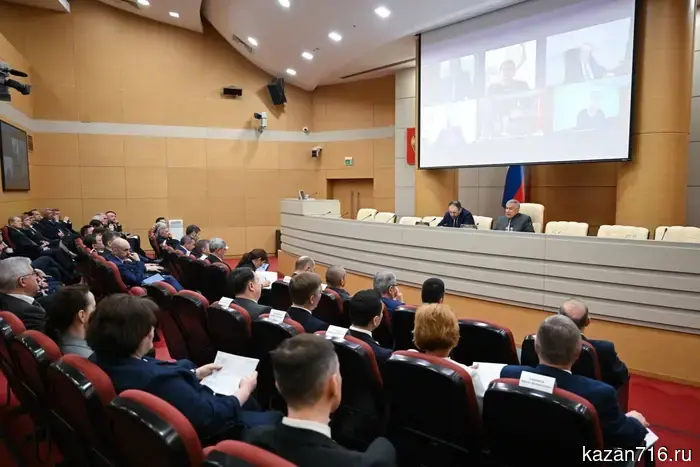
The connection between science and production needs to be strengthened, said the head of the republic, Rustam Minnikhanov, today at a meeting of the Council under the President of Tatarstan for Education and Science. "It is important that scientific and production cooperation becomes a widespread and comprehensive phenomenon. Our task is to use this mechanism as effectively as possible to solve strategically important tasks. The issue of forming a long-term qualified order for scientific research and experimental design work by leading enterprises in Tatarstan is particularly important," said the President of Tatarstan (the video was published by the press service of the President of Tatarstan). The benchmark for this work was set by the President of Russia, Vladimir Putin. Back in 2024, the head of state set a national goal - to ensure technological leadership, designating it as the most important.
3.2 billion rubles for technological leadership
Higher education institutions and scientific organizations in Tatarstan are actively engaged in achieving the national goal. Under the national project "New Materials and Chemistry," Kazan Federal University is developing import-substituting catalysts and reagents for the Russian oil and gas industry. Kazan National Research Technological University has received the right to create an engineering development center and federal subsidies for training highly qualified personnel. Kazan National Research Technical University (KAI) has become an anchor resident of the scientific production center for unmanned aerial systems. Under the national project "Means of Production and Automation," the first federal center for the development of industrial robotics is successfully operating at Innopolis University. "I expect that our universities and research institutions will continue to intensively increase their presence in all national projects for technological leadership," noted Minnikhanov. For technological leadership tasks in the republic, 3.2 billion rubles have been allocated for national projects such as: "Means of Production and Automation," "Food Security," "New Materials and Chemistry," "New Health Preservation Technologies," and "Development of a Multi-Satellite Orbital Group." Tatarstan has adopted its own long-term program for scientific and technological development at the initiative of the Academy of Sciences of Tatarstan. Over the past five years, internal expenditures on scientific research have tripled.
"Separate successful examples are not enough"
The leadership of Russia has not only formulated the main goals in the scientific and technical sphere but also proposed a specific mechanism for achieving them, said Minnikhanov. This includes subsidizing scientific research and experimental design work, providing tax preferences, and establishing a long-term qualified order for R&D, he clarified. "All of them are aimed at expanding the links between science and production," noted the President of Tatarstan. He added that there are successful examples in Tatarstan. For instance, scientific divisions and design bureaus operate within large republican enterprises. With the support of industrial partners - high-tech companies - six advanced engineering schools are functioning. "But these separate successful examples are not enough," stated Minnikhanov.
"The republic has all the prerequisites for developing technologies based on its own raw materials"
The problems hindering the development of scientific research were outlined by the Minister of Industry and Trade of Tatarstan, Oleg Korobchenko. He named several reasons why funding for R&D is still at a low level: the long cycle from idea to prototype, a shortage of engineering personnel, lack of funds for conducting R&D, and a long payback period for costs, a gap between universities and production, the complexity of obtaining subsidies for R&D, and a lack of government support measures. "The current level of R&D funding in advanced countries is between 3% and 5% of GDP. In Russia, this figure is 1%," emphasized Korobchenko. The President of Russia has set the task of increasing expenditures on research and development to at least 2% of GDP by 2030, he reminded. "In the republic, we are already changing our approach from one-time qualified orders to long-term ones. In the global innovation index, Russia ranks 59th. The share of innovative products should be at least a quarter; in Russian industry, it reaches 6.3%, while in Tatarstan, it is 23.5%. The republic has all the prerequisites for developing technologies based on its own raw materials," stated the minister.
"It is important for enterprises to form demand for developments in advance"
Korobchenko, like Minnikhanov, called for strengthening the link between industry and science. "For a stable long-term order, companies need to create conditions for conducting R&D. Tax incentives must be completely transparent for enterprises and stimulate the creation of innovative products. Then the lost revenues for the state will return to the budget multiple times - through VAT and profit taxes," he said. The minister specified the idea of the President of Tatarstan regarding long-term orders. According to him, enterprises need to form demand for developments in advance - to plan technical assignments for universities and research organizations at least three years ahead. It is also necessary to develop proactive training of engineering personnel, he is convinced.
"Convenient platforms are needed for researchers and businesses to communicate"
In Tatarstan, the "link" between scientists from universities and research institutes, development institutions, and enterprises is being consistently implemented, noted Igor Bikeyev, the first vice-rector, vice-rector for scientific work at KFU, professor, and deputy of the State Council of Tatarstan, in a conversation with a correspondent from "Tatar-inform." "To successfully solve this task, in my opinion, convenient and effective platforms are needed where researchers and businesses can communicate, learn about mutual needs, formulate proposals, and negotiate. They should see, hear, and understand each other," he stated. Bikeyev noted that the Academy of Sciences of Tatarstan is doing a lot of work to bring scientists closer to the real sector of the economy. "Particular attention is paid to involving and supporting young researchers. These efforts will undoubtedly yield significant positive effects both in the near and distant future," he is convinced. "For a long time, many domestic enterprises have been accustomed to purchasing ready-made goods and technologies from currently unfriendly countries, which has now become impossible for obvious reasons. It was more convenient: you looked, studied reviews, chose, and took. But if you order new research and developments, firstly, they may take a long time, and secondly, there is a risk that something will not turn out exactly as you wanted," added the university vice-rector.
However, he said, the situation is changing rapidly. "The leadership of the country, headed by President Vladimir Putin, is working to ensure technological sovereignty in key areas, and enterprises have realized that relying solely on foreign suppliers in the current conditions of international turbulence is extremely dangerous," concluded the deputy.
"There are many developments waiting for their time"
Breakthrough developments are "born" only through the interaction of scientific institutions and enterprises, said Farid Basharov, the general director of the Chamber of Commerce and Industry of Naberezhnye Chelny, to "Tatar-inform." "The task of technological sovereignty has been set. When it comes to modern technologies aimed at the future, this is only possible in cooperation with science, in symbiosis with scientific institutions," he noted. According to Basharov, for businesses to have demand for the developments of scientific institutions, enterprises must have the capacity to implement innovations. "That is, the enterprise must be firmly on its feet. There are many developments that could come to life, but some startups are in a difficult position, despite the support measures. There are many developments that are waiting for their time today. There is a lack of proper orchestration. It is clear that the economy earns money from large enterprises; they produce a huge volume of products and pay taxes. But today, we need to turn even more towards innovators. Science can assess the prospects and feasibility of developments," he shared his opinion.
Photo: rais.tatarstan.ru
Другие Новости Казани (Казань716)
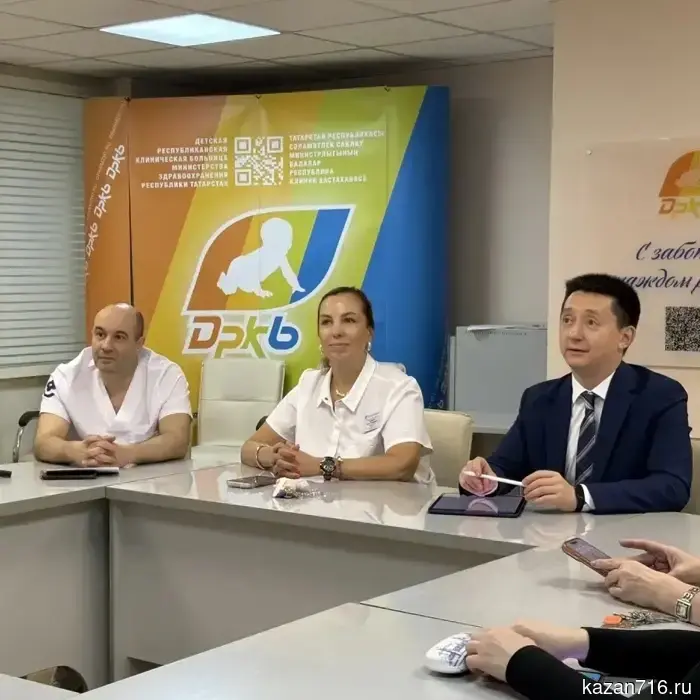 Video conference between specialists of the Children's Republican Clinical Hospital of Tatarstan and the leading Turkish clinic "Doru"
In anticipation of the XVII International Economic Forum "Russia - Islamic World: KazanForum," which has become a key platform for strengthening partnership relations, 04.16.2026. Children's Clinical Hospital. Republic of Tatarstan. Kazan.
Video conference between specialists of the Children's Republican Clinical Hospital of Tatarstan and the leading Turkish clinic "Doru"
In anticipation of the XVII International Economic Forum "Russia - Islamic World: KazanForum," which has become a key platform for strengthening partnership relations, 04.16.2026. Children's Clinical Hospital. Republic of Tatarstan. Kazan.
 "Hero of what? Killing neighbors?" In Tatarstan, in the spring, at least four 18-19-year-old young men who died in the war in Ukraine were buried.
In the spring, it became known about at least four residents of Tatarstan aged 18-19 who died in the war in Ukraine. Recent high school graduates and participants of "Yunarmiya" find themselves on the front line just a few months after being drafted or even signing contracts themselves. Against the backdrop of active...
A fourth grader fell out of a school window in Kazan.
The child has been hospitalized in the Children's Republican Clinical Hospital, his condition is assessed as serious.
An emergency occurred at Kazan School No. 98: a fourth-grade student fell out of a window located on the third floor. 04/16/2026. Chistopol-Inform. Republic of Tatarstan. Chistopol.
Farid Mukhametshin on the Victory Dictation: We must remember our Heroes
Today, an exhibition opened at the Great Patriotic War Memorial Museum of the Kazan Kremlin, 16.04.2026. United Russia. Republic of Tatarstan. Kazan.
Members of the Association of Women Deputies "Mercy-Compassion" discussed proposals for the people's program of the United Russia party.
Today in Kazan, at the venue of the Public Support Headquarters of the Republic of Tatarstan, an expert session of women deputies titled "Women's Priority" took place to discuss and gather proposals for the People's Program of the "United Russia" Party. 16.04.2026. State Council. Republic of Tatarstan. Kazan.
Agriculture through the eyes of schoolchildren: the agro-technology class of Shushmabash School gathered young researchers of their native land.
Today, the II Republican Scientific and Practical Conference "Horizons of My Village" named after 16.04.2026 took place in the agro-technical class of Shushmabash Secondary School of the Arsky Municipal District of the Republic of Tatarstan. Ministry of Agriculture. Republic of Tatarstan. Kazan.
"Hero of what? Killing neighbors?" In Tatarstan, in the spring, at least four 18-19-year-old young men who died in the war in Ukraine were buried.
In the spring, it became known about at least four residents of Tatarstan aged 18-19 who died in the war in Ukraine. Recent high school graduates and participants of "Yunarmiya" find themselves on the front line just a few months after being drafted or even signing contracts themselves. Against the backdrop of active...
A fourth grader fell out of a school window in Kazan.
The child has been hospitalized in the Children's Republican Clinical Hospital, his condition is assessed as serious.
An emergency occurred at Kazan School No. 98: a fourth-grade student fell out of a window located on the third floor. 04/16/2026. Chistopol-Inform. Republic of Tatarstan. Chistopol.
Farid Mukhametshin on the Victory Dictation: We must remember our Heroes
Today, an exhibition opened at the Great Patriotic War Memorial Museum of the Kazan Kremlin, 16.04.2026. United Russia. Republic of Tatarstan. Kazan.
Members of the Association of Women Deputies "Mercy-Compassion" discussed proposals for the people's program of the United Russia party.
Today in Kazan, at the venue of the Public Support Headquarters of the Republic of Tatarstan, an expert session of women deputies titled "Women's Priority" took place to discuss and gather proposals for the People's Program of the "United Russia" Party. 16.04.2026. State Council. Republic of Tatarstan. Kazan.
Agriculture through the eyes of schoolchildren: the agro-technology class of Shushmabash School gathered young researchers of their native land.
Today, the II Republican Scientific and Practical Conference "Horizons of My Village" named after 16.04.2026 took place in the agro-technical class of Shushmabash Secondary School of the Arsky Municipal District of the Republic of Tatarstan. Ministry of Agriculture. Republic of Tatarstan. Kazan.
Science on demand: Minnikhanov called for cooperation between universities and businesses for technological leadership
Over five years, expenditures on scientific research in Tatarstan have tripled Long-term order for research and development work The connection between science and production needs to be strengthened, 16.04.2026. IA Tatar-inform. Republic of Tatarstan. Kazan.