
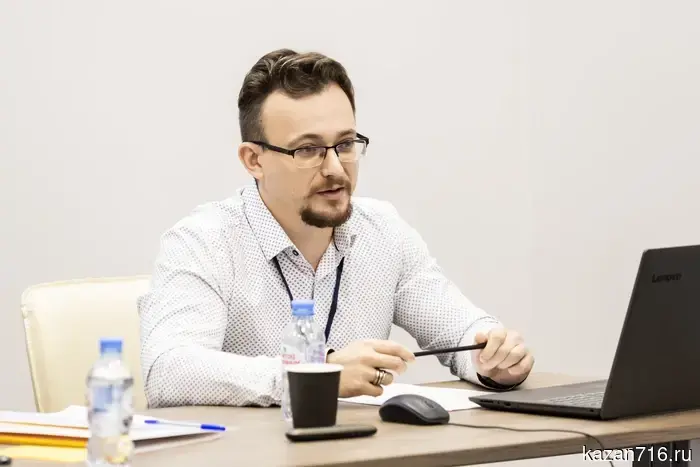
A chemist from KFU explained which elements turn a battery and a broken thermometer into a real chemical hazard.
An expert explained why mercury cannot be ventilated out of an apartment, what actually happens inside spent power sources, and how to act when a thermometer breaks.
Spent batteries, broken thermometers, and failed mercury lamps are all potential sources of chemical threats. Arthur Khannanov, an associate professor at the Department of Inorganic Chemistry at the A.M. Butlerov Chemical Institute of Kazan Federal University, clarified the mechanisms of toxic substances' effects on humans and the environment, as well as dispelled misconceptions about household neutralization of dangerous pollutants. "The threat posed by spent batteries and damaged thermometers lies in completely different planes. The components of power sources consist of active metals, particularly lithium and nickel, and in rare cases, cadmium. When the integrity of the casing is compromised, these components begin to actively interact with moisture, turning into highly aggressive compounds such as alkali. Under certain conditions, a battery can catch fire. This is a direct physicochemical danger," commented the associate professor.
Mercury, a key component of classic medical thermometers, has a completely different mechanism of action. "When entering the body, this metal exerts a toxic effect, affecting numerous organs and systems. Due to its specific similarity in electronic configuration, the substance can literally substitute for calcium in biological processes. Being highly active in itself, it causes systemic harm to human health," emphasized Arthur Khannanov.
Speaking about the durability of various types of measuring devices and power sources, the specialist notes that the lifespan of a mercury thermometer is practically unlimited. "In laboratory practice, for example, we still successfully use high-precision devices that were produced back in the 1960s," the chemist said.
The situation is different with batteries and accumulators. "Any battery or accumulator is primarily a chemical source of current, representing a galvanic element. Essentially, it is a closed system with a limited volume of space and a strictly defined amount of matter. Inside this system, the components gradually enter into a chemical reaction with each other, resulting in the generation of electric current. Like any other reaction, this process slows down over time. As long as there are many active components in the system, the interaction proceeds intensively, providing the equipment with a constant and sufficient flow of electrons. But as soon as the laws of chemical thermodynamics lead to a decrease in the reaction rate, the power source fails. It is important to understand that the components inside do not disappear; they simply transition from one chemical form to another," explained A. Khannanov.
The entry of mercury-containing devices and electronic components into the thermal waste processing system poses a particular danger. "If the components of mercury lamps or any other electronics enter the thermal processing cycle at waste incineration plants, they are subjected to high temperatures and turn into oxides. It is important to understand that oxides often have significantly greater chemical activity than the original substances. While pure mercury is quite inert and reluctant to engage in chemical reactions, its oxides, on the contrary, are reactive. During combustion, substances transition into a new form, which becomes more aggressive and dangerous for the environment," he reported.
Commenting on the mechanism of toxicants' effects on humans, the scientist draws attention to the anatomical features of our body. "The main reason lies in physiology: the internal surface area of the lungs is colossal, comparable to the area of a football field along with all the spectator seats. Thanks to such a huge 'filter,' our body can instantly absorb a critical volume of any toxicant. Specifically regarding mercury: its vapors penetrate the body instantly and in huge doses. The greatest danger comes from fine-dispersed mercury, the smallest droplets. The situation is exacerbated by the high heat capacity of mercury: it effectively absorbs heat from the surrounding environment, which only supports the evaporation process," the specialist explained.
According to the expert, cleaning a room of mercury is extremely difficult due to its high surface energy. "There is even a special method for studying porous bodies – mercury porometry. This method is based on the ability of the substance to penetrate the pores of materials down to the molecular level. When it lands on surfaces, microdroplets of mercury get stuck in cracks and pores, remain there, and continue to evaporate slowly over a long time. It is this prolonged process of vapor release that creates a heavy toxic effect," warned Arthur Khannanov.
The common belief that the surface of a room where a thermometer broke can be neutralized with bleach or potassium permanganate is, according to the associate professor, a dangerous myth. "Despite the availability of modern mercury-free alternatives, many people, especially older generations, continue to prefer classic mercury measuring devices out of habit. If such an incident does occur, only iron chloride can realistically help neutralize mercury. This substance is easy to find in any radio electronics store," noted the expert.
If a mercury thermometer breaks in a room, it is important to follow a clear sequence of actions to minimize the risk of poisoning. "First, you need to open a window to ensure a flow of fresh air. Be sure to wear a cotton-gauze mask to protect your respiratory organs from mercury vapors. Try to carefully gather the small metal beads into one large drop. After that, transfer it to a glass container (a cup or jar). Pour water over the collected mercury. The layer of water will act as a barrier to its evaporation, significantly reducing the toxic effect in the room. Call the emergency services and wait for specialists to arrive to hand over the collected mercury for professional disposal," he concluded.
When partially or fully reprinting the material, as well as quoting, it is necessary to refer to the press service of KFU. Join the KFU channel on MAX.
Author: Amina Murat, Department of Information Policy of KFU, photo: Kirill Kukhmar, TASS
Source: KFU
30.04.2026 16:31
More news about the event:
A thermometer broke, and you are being poisoned for months: KFU chemist on the deadly danger of mercury and batteries
Associate Professor of Inorganic Chemistry at KFU Arthur Khannanov explained the mechanisms of toxic substances' effects from batteries and mercury devices. 16:57 30.04.2026 TRK Tatarstan-New Century - Kazan
KFU chemist explained what elements turn a battery and a broken thermometer into a real chemical danger
The expert explained why mercury cannot be ventilated out of an apartment, what actually happens inside spent power sources, and how to act when a thermometer breaks. 16:31 30.04.2026 KFU - Kazan
Другие Новости Казани (Казань716)
 In the ancient Pokrovsky temple in the village of Yantsevary, the first Liturgy in 90 years was held.
In the ancient Pokrovsky temple in the village of Yantsevary (Pestrechinsky district of Tatarstan), the first Divine Liturgy in 90 years was held. 30.04.2026. Kazan Diocese. Republic of Tatarstan. Kazan.
In the ancient Pokrovsky temple in the village of Yantsevary, the first Liturgy in 90 years was held.
In the ancient Pokrovsky temple in the village of Yantsevary (Pestrechinsky district of Tatarstan), the first Divine Liturgy in 90 years was held. 30.04.2026. Kazan Diocese. Republic of Tatarstan. Kazan.
 In the ancient Pokrovsky church in the village of Yantsevary, the first Liturgy in 90 years was held.
In the ancient Pokrovsky temple in the village of Yantsevary (Pestrichinsky District of Tatarstan), the first Divine Liturgy in 90 years was held. 30.04.2026. Kazan Diocese. Republic of Tatarstan. Kazan.
In the ancient Pokrovsky church in the village of Yantsevary, the first Liturgy in 90 years was held.
In the ancient Pokrovsky temple in the village of Yantsevary (Pestrichinsky District of Tatarstan), the first Divine Liturgy in 90 years was held. 30.04.2026. Kazan Diocese. Republic of Tatarstan. Kazan.
 The gross profit of KAMAZ under RAS in the first quarter increased sevenfold.
The gross profit of PJSC "KAMAZ" according to RAS in the first quarter of 2026 increased sevenfold compared to the same period in 2025 - to 1.4 billion rubles. 30.04.2026. IA Tatar-inform. Republic of Tatarstan. Kazan.
The gross profit of KAMAZ under RAS in the first quarter increased sevenfold.
The gross profit of PJSC "KAMAZ" according to RAS in the first quarter of 2026 increased sevenfold compared to the same period in 2025 - to 1.4 billion rubles. 30.04.2026. IA Tatar-inform. Republic of Tatarstan. Kazan.
 Results of the event "Tunnel" in Zainsk: 11 violations in one raid
On April 30, during the operational and preventive event "Tunnel," employees of the State Traffic Safety Inspectorate of the Ministry of Internal Affairs for the Zainsk District identified 11 instances of violations of legislation.
As a result of preventive work, to the admin 30.04.2026. News of Zainsk. Republic of Tatarstan. Zainsk.
Results of the event "Tunnel" in Zainsk: 11 violations in one raid
On April 30, during the operational and preventive event "Tunnel," employees of the State Traffic Safety Inspectorate of the Ministry of Internal Affairs for the Zainsk District identified 11 instances of violations of legislation.
As a result of preventive work, to the admin 30.04.2026. News of Zainsk. Republic of Tatarstan. Zainsk.
 In the ancient Pokrovsky temple in the village of Yantsevary, the first Liturgy in 90 years was held.
In the ancient Pokrovsky church in the village of Yantsevary (Pestrechinsky district of Tatarstan), the first Divine Liturgy in 90 years was held. 30.04.2026. Kazan Diocese. Republic of Tatarstan. Kazan.
In the ancient Pokrovsky temple in the village of Yantsevary, the first Liturgy in 90 years was held.
In the ancient Pokrovsky church in the village of Yantsevary (Pestrechinsky district of Tatarstan), the first Divine Liturgy in 90 years was held. 30.04.2026. Kazan Diocese. Republic of Tatarstan. Kazan.
A chemist from KFU explained which elements turn a battery and a broken thermometer into a real chemical hazard.
An expert explained why it is impossible to ventilate mercury out of an apartment, what actually happens inside used power sources, and how to act in case of a broken thermometer. 30.04.2026. KFU. Republic of Tatarstan. Kazan.