

Anvar Zakirov: If the debtor is not a malicious non-payer, we do not take aggressive measures.
The Chief Bailiff of Tatarstan on how the service's work has changed, debt collection, and the use of AI
Photo: Artem Dergunov
The Chief Bailiff of Tatarstan, Anvar Zakirov, in an interview with the editor-in-chief of "Realnoe Vremya," spoke about the structure of collections, who does not pay alimony, how effective joint raids with the traffic police are, and what to do to avoid being among the debtors.
A significant portion of debts is alimony
— How much debt was collected in 2025 and what is the structure of collections? In 2025, over 22 billion rubles were collected. In the first quarter of the current year, over 5 billion rubles of debt were collected. A significant portion is alimony (over 1 billion rubles have already been collected), followed by fines, taxes, loan payments, housing and communal payments, and salaries.
— Is the amount of collected debts increasing and what is it related to?
Yes, the amount of collected debts is increasing every year. This is partly due to the growth of wages, as well as the optimization of the work of bailiffs: they are more thorough in processing each enforcement case—checking for the presence of property, accounts, and sources of income.
Dinar Fatykhov / realnoevremya.ru
— How many enforcement cases are currently in progress and how are they distributed by types of debts?
The most significant share of debts we have in progress is credit payments. There are constantly about 1.3 million enforcement cases in progress. Of these:
about 15 thousand—on alimony;
more than 60 thousand—on taxes;
about 30 thousand—on utility debts.
Over the past 5 years, the number of unfinished enforcement cases on alimony has decreased from 20 to 15 thousand.
— Are there large lots of debts? What are these lots and what is their approximate price?
Large lots are usually premises, buildings, and land plots. Among the latest lots are objects worth about 32-45 million rubles. Cars are also put up for sale. So far, there have been no airplanes or helicopters.
It is recommended to check for debts at least once a quarter
— How can citizens check if they have debts?
You can check for debts:
On the website of the Federal Bailiff Service of Russia or on the website of the Main Department of the Federal Bailiff Service for the Republic of Tatarstan—through the database of enforcement proceedings (you need to enter your full name);
In your personal account on the Unified State Services Portal: if you have a subscription, information about the initiation and completion of enforcement proceedings and copies of rulings are sent there.
Dinar Fatykhov / realnoevremya.ru
The database is also useful for checking future counterparties—for example, before buying a car or an apartment.
— How often should one check for debts?
It is recommended to check at least once a quarter. It is especially important to do this before planning a trip abroad.
— Is it common for a person to be unaware of their debt?
This used to happen quite often, but after integration with the Unified State Services Portal, such cases have become rare. Typically, debtors receive several notifications about their debts:
when brought to administrative responsibility (protocols are drawn up, fines are imposed);
from utility organizations (claim work);
from the court (notification of a hearing or a copy of the court order).
— What should you do if you find a debt in the database?
You need to pay the debt and notify the bailiff about it. You can pay:
on the website of the Federal Bailiff Service of Russia (there is a "Pay" button);
in the online application of any bank.
— How long does it take to close an enforcement case after paying the debt?
The time depends on the method of payment:
if you paid directly to the creditor and sent a copy of the receipt to the bailiff—3-5 days;
if you paid into the deposit account of the department—up to 5 days for the money to arrive through the treasury plus time for the distribution of funds and confirmation of receipt by the creditor (in total, it can take up to 2 weeks).
Dinar Fatykhov / realnoevremya.ru
The bailiff does not seize property for debts up to 3 thousand
— At what point do restrictions (on leaving the country, on registration actions, etc.) appear?
When the enforcement document arrives at the bailiff service, requests are immediately sent to the registering authorities (traffic police, Rosreestr, banks, etc.). By the expiration of the term for voluntary execution (5 days), the bailiff receives responses and makes decisions on imposing seizures and restrictions.
— At what amount of debt can property be seized?
The bailiff does not seize property for debts up to 3 thousand rubles, but can impose a restriction on registration actions (for real estate and vehicles). For debts over 3 thousand rubles, the bailiff has the right to impose a seizure.
— Can an apartment be seized due to debts on fines?
Theoretically, yes, but in practice, no one will seize an apartment worth a million rubles for a small debt (for example, 5 thousand rubles). However, if the debtor has a car worth 100 thousand rubles and fines of 50 thousand rubles, the bailiffs have the right to seize and confiscate the car, placing it in a penalty parking lot. After the debt is settled, the car will be returned to the owner.
Artem Dergunov / realnoevremya.ru
— What types of restrictions can be imposed on the debtor's property?
A restriction on registration actions— the citizen can own the property but cannot dispose of it (sell, gift, etc.).
Seizure of property—includes a restriction on registration actions and the preparation of an inventory act with the participation of witnesses. The property (household items, vehicles, real estate) is assessed and may be put up for sale.
Cameras along the road read license plates and show online which car is involved in enforcement proceedings
— How are raids conducted to collect traffic fines?
Raids are conducted weekly according to a plan agreed with the traffic police. The hardware and software complex "Road Bailiff" is used: it uploads the database of bailiffs with the license plates of cars related to enforcement proceedings. Cameras along the road read the license plates and show online which car is involved in enforcement proceedings and what the amount of debt is. This allows for targeted work—only stopping the necessary cars.
— Does the collection of fines directly on the road affect drivers' behavior in the future?
Yes, it does. Analysis has shown that if a driver with more than 10 traffic fines is stopped and fined, then within six months, they typically do not accumulate that number of fines again (this applies to about 80-90% of drivers).
Maxim Platonov / realnoevremya.ru
— How is the work of bailiffs organized with different categories of enforcement proceedings?
The work is structured and specialized. For example: more than 50 bailiffs across the republic are engaged solely in collecting alimony, and there is a department in Kazan for electronic enforcement that processes traffic fines and other authorized bodies electronically. Different algorithms are applied for different categories of debts (housing payments, loans, etc.).
Bailiffs do not chase every debtor—they optimize the workload and choose the most effective collection measures depending on the amount of debt, the debtor's financial situation, and other factors.
Pets are not seized anymore
— Tell us how the sale of seized property—cars, apartments, etc.—is carried out? And is it true that pets could once be seized?
Pets are not seized anymore—the law has changed. Any property that is seized by the bailiff (or confiscated in accordance with a court decision) is processed through a list of documents—an act of seizure with marks of confiscation or transfer for storage (to the debtor, a third party, or the creditor). Measures are then taken for evaluation, and a package of documents is formed for the transfer of property for sale—it is sent to the apparatus of the Main Department of the Federal Bailiff Service of Russia for the Republic of Tatarstan. There, the department for organizing the sale of debtors' property and their search checks the completeness and legal correctness of the documents. After that, the papers go to Rosimushchestvo—it organizes the auctions. Our task is to identify, seize, prepare documents, and transfer for sale.
— How long does seized property (apartment, car) remain in seized status before being transferred for sale?
From the date of the seizure act, 10 days are given for appeal. If the debtor does not appeal, measures are taken for evaluation. In certain cases, the bailiff may conduct the evaluation themselves—they issue a ruling, send it to the debtor and the creditor. Another 10 days are given for appealing the evaluation. Then a request for sale is formed, and the property is transferred for auction. Overall, excluding court disputes, the process can take a month to a month and a half. But if someone (for example, a third party) wants to exclude the property from seizure or the debtor disputes the seizure act, the timelines are extended—you have to wait for a court decision.
Realnoe Vremya / realnoevrem
Другие Новости Казани (Казань716)
 BAZA: two people died from electric shock in a fountain at a café in Bulgaria
In Bolgar, on the territory of a café on Pioneer Street, the owner of the Armenian café "Sako" was cleaning a fountain and received an electric shock. 12.05.2026. TRK Tatarstan-New Century. Republic of Tatarstan. Kazan.
In Bashkiria, a one-and-a-half-year-old child drowned in the Ay River.
In Bashkortostan, investigators have opened a criminal case regarding the death of a minor child who was left unattended by adults during a nature outing. 12.05.2026. Newspaper Novaya Kama. Republic of Tatarstan. Yelabuga.
BAZA: two people died from electric shock in a fountain at a café in Bulgaria
In Bolgar, on the territory of a café on Pioneer Street, the owner of the Armenian café "Sako" was cleaning a fountain and received an electric shock. 12.05.2026. TRK Tatarstan-New Century. Republic of Tatarstan. Kazan.
In Bashkiria, a one-and-a-half-year-old child drowned in the Ay River.
In Bashkortostan, investigators have opened a criminal case regarding the death of a minor child who was left unattended by adults during a nature outing. 12.05.2026. Newspaper Novaya Kama. Republic of Tatarstan. Yelabuga.
 Anvar Zakirov: If the debtor is not a malicious defaulter, we do not take aggressive measures.
The chief bailiff of Tatarstan on how the work of the service has changed, on debt collection, and the use of AI
Photo: 05.13.2026. Real Time. Republic of Tatarstan. Kazan.
In Tatarstan, the airline was penalized for excess tickets for the flight to Moscow.
The carrier will now have to pay a fine. One of the passengers ultimately did not have enough space on the plane. 12.05.2026. Komsomolskaya Pravda Kazan. Republic of Tatarstan. Kazan.
Anvar Zakirov: If the debtor is not a malicious defaulter, we do not take aggressive measures.
The chief bailiff of Tatarstan on how the work of the service has changed, on debt collection, and the use of AI
Photo: 05.13.2026. Real Time. Republic of Tatarstan. Kazan.
In Tatarstan, the airline was penalized for excess tickets for the flight to Moscow.
The carrier will now have to pay a fine. One of the passengers ultimately did not have enough space on the plane. 12.05.2026. Komsomolskaya Pravda Kazan. Republic of Tatarstan. Kazan.
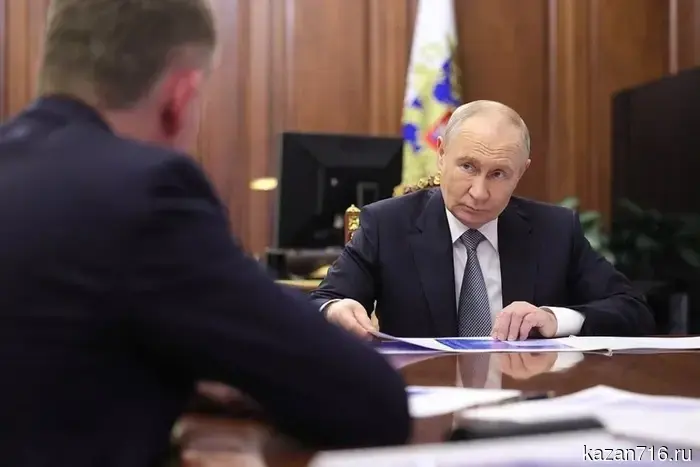 Putin met with the head of the Ministry of Economic Development Reshetnikov: main points
The President noted positive macroeconomic trends in Russia
Photo: Press Service of the Kremlin
The President of Russia, Vladimir Putin, met with the head of the Ministry of Economic Development, Maxim Reshetnikov. 12.05.2026. Real Time. Republic of Tatarstan. Kazan.
In Tatarstan, an airline was penalized for excess tickets for the flight to Moscow.
The carrier will now have to pay a fine. One of the passengers ultimately did not have enough space on the plane. 12.05.2026. Komsomolskaya Pravda Kazan. Republic of Tatarstan. Kazan.
Putin met with the head of the Ministry of Economic Development Reshetnikov: main points
The President noted positive macroeconomic trends in Russia
Photo: Press Service of the Kremlin
The President of Russia, Vladimir Putin, met with the head of the Ministry of Economic Development, Maxim Reshetnikov. 12.05.2026. Real Time. Republic of Tatarstan. Kazan.
In Tatarstan, an airline was penalized for excess tickets for the flight to Moscow.
The carrier will now have to pay a fine. One of the passengers ultimately did not have enough space on the plane. 12.05.2026. Komsomolskaya Pravda Kazan. Republic of Tatarstan. Kazan.
Anvar Zakirov: If the debtor is not a malicious non-payer, we do not take aggressive measures.
The Chief Bailiff of Tatarstan on how the work of the service has changed, on debt collection, and the use of AI Photo: 05.13.2026. Real Time. Republic of Tatarstan. Kazan.