
Soldier Kotdus Mulyukov from Buinsk warmed his comrades with the overcoats he had sewn.
Kotdus Mulyukov, who went to the Great Patriotic War at the age of seventeen, warmed his comrades with the overcoats he sewed, while meeting the enemy with the fire of artillery shells. At the festive evening dedicated to the 99th anniversary of the veteran, which took place on May 10 at the cultural center of his native village of Aksu, bright pages of his life, full of courage and skill, were remembered. Life with a stepmother taught Kotdus the craft. He was born the fourth child in the family. His father Garifulla was a man who participated in wars for more than 13 years and had seen the revolution. He was respected in the village for his hard work and fairness. Garifulla was a skilled tailor and owned many horses. His steeds shone at the sabantuy festivals. During the years of collectivization, he transferred them to the collective farm. Kotdus's mother Bibilatifa passed away when he was only seven months old. Until the age of seven, the boy grew up under the care of his grandmother. Then his father remarried, and the family had four more children. Having lost his mother, Kotdus was afraid of losing his father as well, so he did not leave his side for a moment. To spend less time with his stepmother, he began to travel with his father to neighboring villages, helping him sew clothes. In winter, the "Singer" sewing machines were set up on sleds, and in summer – on carts. Together they sewed dresses, shirts, and coats for the villagers, as well as repaired old things. Thus, they helped people dress and were fed themselves during difficult years. When Kotdus turned 14, the Great Patriotic War began. His brothers Davletgali, Nabiulla, and Abdelmalik went to the front one after another. He also wanted to be with his brothers, not with his stepmother. The teenager, who plowed the land alongside adults, gathered firewood, and dug trenches, dreamed of going to war as soon as possible. In November 1944, 17-year-old Kotdus received a summons from the military enlistment office. "The preparations were brief. I took only warm clothes and the essentials with me. A few days later, we were sent to the Ulyanovsk region for short-term training," recalls the veteran of those days. Then, as part of the 83rd artillery regiment, he participated in battles for the liberation of Lithuania, Latvia, and Estonia. His last battle took place in 1945 near Kaunas. It was a long and fierce battle. The barrels of the anti-aircraft guns overheated from continuous firing, and the soldiers' tunics soaked with blood. In this battle, they lost their commander Chernokhovsky. Kotdus miraculously survived. Heavily wounded in the leg, the soldier was carried off the battlefield by medics and sent to the hospital. He heard the news of Victory while already in Vilnius. "Out of joy, the soldiers didn't know what to do. Some cried, some laughed. They hugged each other and congratulated one another," recalls the war veteran, remembering Victory Day. The young soldier, who poured fire on the enemy as a gunner, also managed to engage in tailoring. His comrades greatly valued his skill and took care of him. "When there was an opportunity, I was not sent to the front. I sewed overcoats for the soldiers," he says. Immediately after the war ended, he did not have the chance to return home. Kotdus remained to serve in the Baltic Military District. The fame of his tailoring skills followed him closely. He sewed clothes for orphans, altered large items, and sewed epaulets onto soldiers' uniforms. The head of a large family It was only six years after the war ended that Kotdus was fortunate enough to meet his relatives in his native home. His brother Nabiulla also returned alive and unharmed, despite news of his death. Their father had foreseen this in a dream: as if three horses were grazing in the yard, while a fourth could not get inside. "My fourth son is also alive," the father said then. His prediction came true. Even in peacetime, Kotdus did not abandon the tailoring craft. He got a job in a sewing workshop in the neighboring Chuvash village of Yalchiki. He started a family with a girl named Nuraniya, who worked in a cafeteria. "We, two orphans, came together. She survived the blockade of Leningrad and was raised by her grandmother until she was ten. It was not difficult for us to start a life together. We knew what life's hardships were," Kotdus Mulyukov recalls those years. They had eight children – four sons and four daughters. To feed the large family, Kotdus worked day and night. At home, he sewed outerwear and hats, which he then sold at the market. In summer, he grew carrots in the garden. The Mulyukovs raised their children to respect work and elders, and also provided them with religious education. All of them found their place in life. Four daughters chose the path of teaching, laying the foundation for a true pedagogical dynasty. Its roots go back to Garif, the village mullah, and span over four centuries. Among the grandchildren and great-grandchildren, there are many who continued family traditions by mastering the craft of sewing. In the Mulyukov home, the memory of ancestors is carefully preserved. Among the relics are a Quran dated to the 1800s, an ancient lamp, and an iron. Items of clothing sewn by the hands of ancestors hold special value. At the genealogy festival "Echo of Centuries in Family History – Tarikhta bez ezlebez," the Mulyukov family presented an exhibition that made an indelible impression on the jury members. They also surprised everyone with the largest number of descendants. There are more than 140 grandchildren and great-grandchildren of Kotdus. Although not everyone could come to the event in honor of his birthday, they will definitely congratulate their beloved relative. And that evening, many kind words were spoken to him by children, grandchildren, and great-grandchildren, as well as by the villagers. The director of the cultural center, Diana Suleymanova, and the head of the library, Alfiya Sharafutdinova, thanked him for accepting the invitation, wished Kotdus aga health and new meetings, and presented him with a gift and a bouquet of flowers. "Thank you very much to everyone for such attention. My greatest wealth is my native village, my large family of over a hundred people, and my fellow villagers. There were difficulties, but we managed to overcome them. The most essential thing for a person is peace, the ability to yield to one another, and kindness. This is the secret of longevity," said the veteran, whose chest is adorned with the medal "For Victory over Germany in the Great Patriotic War 1941-45," the Order of the Patriotic War II class, and many other awards.
Другие Новости Казани (Казань716)
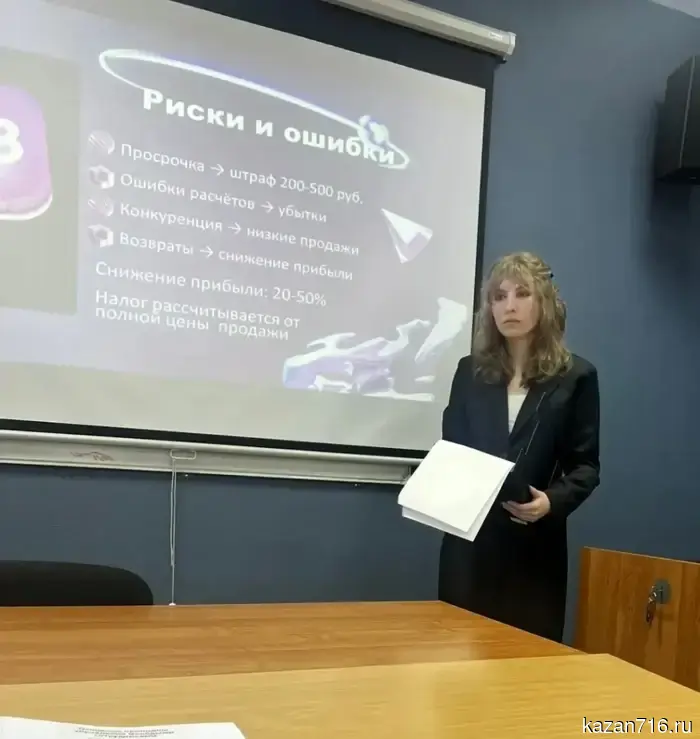 When students teach students, magic is born!
The college welcomes experiments and unconventional approaches, so the defense of individual projects this year took place in a special format. 14.05.2026. KIU. Republic of Tatarstan. Kazan.
When students teach students, magic is born!
The college welcomes experiments and unconventional approaches, so the defense of individual projects this year took place in a special format. 14.05.2026. KIU. Republic of Tatarstan. Kazan.
 Residents of the "Seasons" residential complex will be without gas supply for three days.
The reason was the gas pipeline re-routing.
Photo: Denis Gordiyko
In the "Seasons of the Year" residential complex in the Privolzhsky district of Kazan, gas supply will be temporarily shut off. 14.05.2026. Administration of Kazan. Republic of Tatarstan. Kazan.
Residents of the "Seasons" residential complex will be without gas supply for three days.
The reason was the gas pipeline re-routing.
Photo: Denis Gordiyko
In the "Seasons of the Year" residential complex in the Privolzhsky district of Kazan, gas supply will be temporarily shut off. 14.05.2026. Administration of Kazan. Republic of Tatarstan. Kazan.
 "United Russia" and the Government have ensured the agricultural leadership of the country.
Secretary of the General Council of the United Russia party, Vladimir Yakushev, at the plenary session of the district reporting and program forum "There is a result! 14.05.2026. IA Tatar-inform. Republic of Tatarstan. Kazan.
"Zenit-Kazan" defeated "Dynamo-LO" and advanced to the semifinals of the Russian Cup from the first place.
The volleyball players of Kazan's "Zenit" defeated "Dynamo" 3:0 in Moscow in the group stage match of the "Final Six" of the Russian Cup and advanced to the semifinals from the first place in the group. 14.05.2026. Business Online. Republic of Tatarstan. Kazan.
"United Russia" and the Government have ensured the agricultural leadership of the country.
Secretary of the General Council of the United Russia party, Vladimir Yakushev, at the plenary session of the district reporting and program forum "There is a result! 14.05.2026. IA Tatar-inform. Republic of Tatarstan. Kazan.
"Zenit-Kazan" defeated "Dynamo-LO" and advanced to the semifinals of the Russian Cup from the first place.
The volleyball players of Kazan's "Zenit" defeated "Dynamo" 3:0 in Moscow in the group stage match of the "Final Six" of the Russian Cup and advanced to the semifinals from the first place in the group. 14.05.2026. Business Online. Republic of Tatarstan. Kazan.
Soldier Kotdus Mulyukov from Buinsk warmed his comrades with the overcoats he had sewn.
Kotdus Mulyukov, who went to the Great Patriotic War at the age of seventeen, warmed his comrades with the overcoats he sewed, while he met the enemy with the fire of artillery shells. 14.05.2026. Newspaper Znamya. Republic of Tatarstan. Buinsk.