
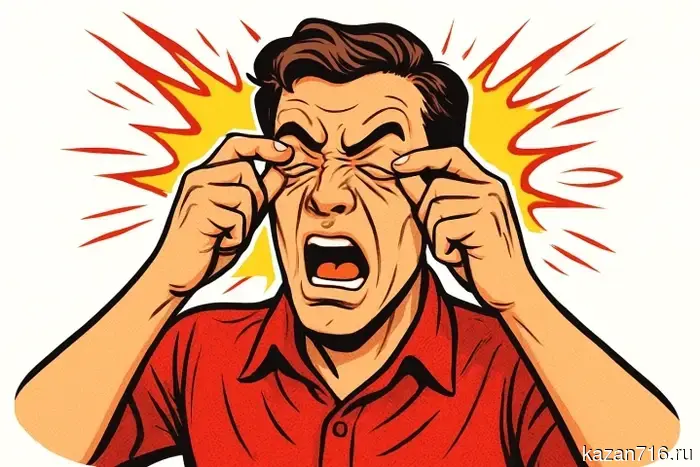
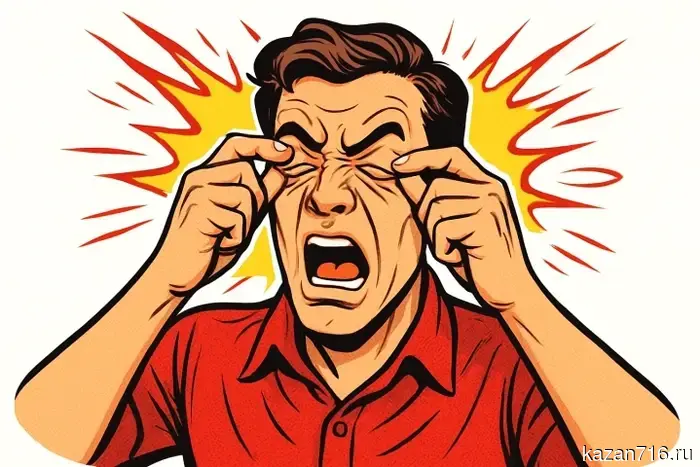
Why eyelids close automatically: the truth about sneezing and eyes
Is it possible to keep your eyes open while sneezing and what will happen if you challenge nature? We analyze the physiology of the reflex, scary stories from the internet, and real risks.
A reflex that cannot be deceived
Try to imagine right now that you are sneezing, but your eyelids remain still. The thought experiment fails almost instantly — the brain refuses to visualize such a picture. And this is not accidental. Sneezing with open eyes is beyond human capabilities, and this is explained not by willpower, but by the rigid programming of our nervous system, laid down by evolution. When the body triggers the sneeze reflex, an unconditional command to close the eyelids simultaneously reaches the brainstem. This process occurs outside the realm of conscious control. Even if you try to hold your eyelids open with your fingers, at the crucial moment they will still flutter and close — such is the strength of this reflexive act.
Why does nature lock the eyes?
From a physiological perspective, there is a clear protective function here. At the moment of a sneeze, the airflow exits the respiratory tract at a tremendous speed, approaching 160 kilometers per hour. Along with this, tiny droplets of saliva, dust particles, allergens, and pathogenic bacteria that caused the irritation are expelled. If the eyelids remained open, this entire microbial cocktail could settle on the delicate cornea, enter the tear ducts, and provoke serious inflammation, conjunctivitis, or even microtraumas. Closed eyelids act as a physical shield, blocking access to sensitive structures of the eye from foreign particles. Additionally, during the sneeze, there is an instant spike in blood pressure inside the head. The eyeball, surrounded by thin vessels and muscle tissue, needs stabilization. Closed eyelids create additional external support, preventing the eye from shifting under the pressure of internal flows.
Will the eyes really pop out?
The most popular scary story on the internet claims that during a sneeze with open eyelids, the eyeballs can leave their sockets. This is nothing more than a beautiful legend without scientific basis. Each eye is securely held in the bony socket by six extraocular muscles, strong ligaments, and fatty tissue, working as a single shock-absorbing mechanism. The pressure generated during a sneeze is insufficient to rupture these tissues. There have even been unofficial experiments where daredevils forcibly held their eyelids open during a sneeze — not a single case of dislocation or vision loss has been recorded. The only real side effect that may occur is ruptured small capillaries on the sclera. A red spot will appear on the eyeball, which will dissolve in a few days, but that is the maximum trouble you might face.
Why is consciousness powerless?
A sneeze is one of the most complexly organized reflexes of the human body. Dozens of muscles are involved: the diaphragm, intercostal muscles, larynx, tongue, abdominal press, and of course, the circular muscles of the eyes. All of them contract in a precisely coordinated sequence with accuracy to fractions of a second. This ancient mechanism for clearing the airways operates autonomously, and consciousness receives only a brief notification of the impending process, with no ability to influence it. Sometimes you can meet people who claim they sneezed with their eyes partially open. In reality, in most cases, this is an illusion: the reflexive closure occurs so instantaneously that the brain simply does not have time to register this fact, creating a false sense of control. Or it was not a full reflexive exhalation, but a weak semblance of it.
Bonus: photic sneeze and evolutionary glitches
By the way, did you know that about 18–35% of people sneeze when looking at bright light? This phenomenon is called the photic sneeze reflex. When a person steps out of darkness into sunlight, the light signal accidentally cross-activates the trigeminal nerve, which is also responsible for sneezing. Evolution has not fully separated these two pathways, but this "glitch" is completely harmless and is considered a normal variation of physiology.
Our body performs thousands of protective operations without our knowledge, and sneezing is just one of them. You do not need to think about closing your eyes, just as you do not need to decide when to take a breath. Millions of years of natural selection have embedded a clear algorithm in the brain: sneezing can only occur with closed eyelids. And you will not be able to break this rule, even if you really want to. The body is always a step ahead of consciousness, and this is its main strength.
Yulia Kazamarova
More news about the event:
Why do eyelids close automatically: the truth about sneezing and eyes
Is it possible to keep your eyes open while sneezing and what will happen if you challenge nature? 13:46 25.06.2026 News of Zainsk - Zainsk
Why do eyelids close automatically: the truth about sneezing and eyes
Is it possible to keep your eyes open while sneezing and what will happen if you challenge nature? 13:24 25.06.2026 Zainsk-inform - Zainsk
Другие Новости Казани (Казань716)
 Russian national football teams under 15 years old have been allowed to participate in the World Cup.
Today it became known that FIFA has allowed the Russian national teams of boys and girls under 15 to participate in the 2026 World Cup. 25.06.2026. IA Tatar-inform. Republic of Tatarstan. Kazan.
Russian national football teams under 15 years old have been allowed to participate in the World Cup.
Today it became known that FIFA has allowed the Russian national teams of boys and girls under 15 to participate in the 2026 World Cup. 25.06.2026. IA Tatar-inform. Republic of Tatarstan. Kazan.
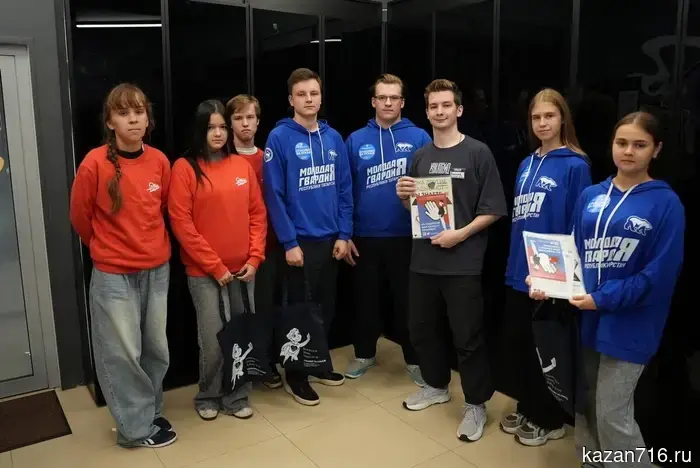 A program to combat the sale of vapes and cigarettes to teenagers has been launched in Tatarstan.
The federal social program to combat smoking and vaping among minors has started in the Republic of Tatarstan. 25.06.2026. Tatar-inform News Agency. Republic of Tatarstan. Kazan.
Consequences of corruption
Corruption in the system of state and municipal governance represents one of the most serious threats to any modern state. 25.06.2026. Menzelya. Republic of Tatarstan. Menzelinsk.
A program to combat the sale of vapes and cigarettes to teenagers has been launched in Tatarstan.
The federal social program to combat smoking and vaping among minors has started in the Republic of Tatarstan. 25.06.2026. Tatar-inform News Agency. Republic of Tatarstan. Kazan.
Consequences of corruption
Corruption in the system of state and municipal governance represents one of the most serious threats to any modern state. 25.06.2026. Menzelya. Republic of Tatarstan. Menzelinsk.
 Almetyevsk bailiffs conducted a raid on chronic debtors.
They usually visit no less than 10 addresses.
The debts of the residents of Almetyevsk to management companies amount to millions of rubles. 25.06.2026. Almetyevsk RTV. Republic of Tatarstan. Almetyevsk.
Almetyevsk bailiffs conducted a raid on chronic debtors.
They usually visit no less than 10 addresses.
The debts of the residents of Almetyevsk to management companies amount to millions of rubles. 25.06.2026. Almetyevsk RTV. Republic of Tatarstan. Almetyevsk.
 Tatarstan sellers are actively mastering marketplaces.
The Republic demonstrates impressive growth rates in e-commerce. 25.06.2026. Bavly-Inform. Republic of Tatarstan. Bavly.
Tatarstan sellers are actively mastering marketplaces.
The Republic demonstrates impressive growth rates in e-commerce. 25.06.2026. Bavly-Inform. Republic of Tatarstan. Bavly.
 The Accounts Chamber of Tatarstan identified violations in state procurement amounting to 171 million rubles over the year.
According to the results of last year, the Accounts Chamber of Tatarstan identified violations in state procurement amounting to 171 million rubles. 25.06.2026. IA Tatar-inform. Republic of Tatarstan. Kazan.
The Accounts Chamber of Tatarstan identified violations in state procurement amounting to 171 million rubles over the year.
According to the results of last year, the Accounts Chamber of Tatarstan identified violations in state procurement amounting to 171 million rubles. 25.06.2026. IA Tatar-inform. Republic of Tatarstan. Kazan.
Why eyelids close automatically: the truth about sneezing and eyes
Is it possible to keep your eyes open while sneezing and what happens if you challenge nature? 06/25/2026. Zainsk-Inform. Republic of Tatarstan. Zainsk.