
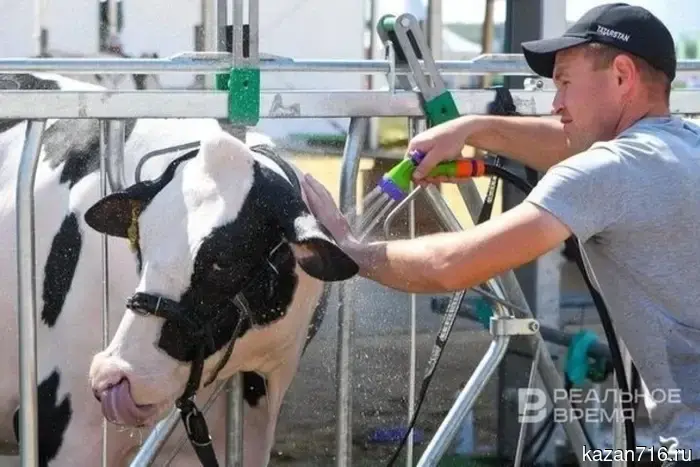
Delivery is only possible with permission: meat prices are rising in Tatarstan.
Against the backdrop of restrictions on the import and export of cattle between regions, the retail price of red meat has risen to 1000 rubles per kilogram.
Photo: Dinara Fatykhova
Amid two weeks of restrictions on the import of livestock, purchase prices for cattle by live weight in Tatarstan have jumped to nearly 350 rubles per kilogram. Following this, retail prices have also increased: the price of beef on the bone in the markets of Kazan reaches 1000 rubles per kg, while in retail it is around 900 rubles per kg. According to Tatarstanstat, on March 23, beef was priced at 695.36 rubles. What is happening with meat prices is discussed in the material from "Real Time."
Tatarstan has suspended cattle supplies from Chuvashia and Orenburg.
Regional markets for livestock products are experiencing severe shocks due to restrictions on the import of cattle from neighboring regions, implemented due to the threat of infectious animal diseases. On March 12, it became known that the Ministry of Agriculture of the republic imposed a ban on the import of animals and feed from other regions of Russia, which is still in effect. "Recently, a Republican headquarters meeting was held to prevent particularly dangerous diseases. A decision was made: for now, we are only allowing the import of breeding animals, ungulates. We continue to operate as we have been. Import is only possible with permission from the Main Veterinary Directorate upon agreement," said Gabdulhak Motygullin, Deputy Head of the Main Veterinary Directorate of the Cabinet of Ministers of Tatarstan, during a live broadcast on March 30.
A screenshot from the RT Center's video broadcast.
It was not specified which specific regions were banned from trading cattle. Sources from "Real Time" in several wholesale companies reported that the restrictions only affected two nearby regions — Orenburg Oblast and Chuvashia, where a complicated epizootic situation has developed. According to managers, such recommendations were received from the state veterinary service of Tatarstan, indicating the need to refrain from purchasing and selling livestock specifically in these regions. The reason for the restrictions in Chuvashia is clear: on March 17, a focus of pasteurellosis was detected in the Batyrievsky district. There have been no reports of similar infections entering Orenburg Oblast. It is likely that the restrictions are related to the region's border with Kazakhstan, from where there is a large flow of livestock and meat supplies, according to cattle buyers.
Transporting and selling cattle to other regions, including the Moscow region, is not prohibited, cattle buyers report. However, the buyer must have a positive conclusion from the veterinary service: the purchase, sale, and transportation of animals must be accompanied by veterinary accompanying documents in the "Mercury" system. They continue to purchase cattle by live weight in the republic and in other regions with subsequent delivery to meat processing plants in the Moscow region. However, they are avoiding the Verkhneuslonsky district, which, according to them, has been "closed." According to buyers, restrictions on import and export have also been introduced by Nizhny Novgorod Oblast.
In Mari El, slaughter in backyards has been banned.
Since March 24, the authorities of Mari El have decided to strengthen control over the import of meat and livestock to prevent the spread of dangerous diseases from neighboring regions. The state veterinary service of Mari El has banned the slaughter of livestock in private backyards and on the premises of farms. Owners are required to carry out slaughter only at specialized points under veterinary control. Importing animals is possible with prior notification, after which the herd must undergo a 30-day quarantine.
Real Time / realnoevremya.ru
Ignoring these requirements puts owners at risk for both their well-being and the food security of the region, warned the state veterinary service of the republic about the personal responsibility of each farmer keeping livestock. Veterinary control posts operate on interregional roads, checking every truck with cattle.
At the same time, local authorities in the regions emphasize that there are no outbreaks of pasteurellosis in cattle. Strict measures are being taken to prevent an outbreak that has been registered in several districts of Novosibirsk Oblast. Other regions of the Volga Federal District have not yet announced any restrictions.
"Farmers manage as they wish."
Against the backdrop of two weeks of restrictions on the import of livestock into Tatarstan, purchase prices for cattle by live weight have jumped to nearly 350 rubles per kilogram.
"Previously, we bought cattle by live weight for 255 rubles per kg and sold it at 600-700 rubles at the stalls. Such prices held until the New Year. Now purchase prices have risen to 330-350 rubles by live weight," said the head of a wholesale company supplying beef for processing in Kazan to "Real Time."
According to him, almost all farms in the republic raised prices after the introduction of restrictions by the state veterinary service. He noted that they used to try to buy bulls, whose meat is in demand in the catering sector (cafes, restaurants) and at factories producing semi-finished products. However, a 40% price increase made purchasing unprofitable.
"It's noticeable — that's putting it mildly. Because of this, we stopped buying bulls for slaughter — it's too expensive for the processor," he shared in a conversation with "Real Time." Wholesalers switched to purchasing breeding cows, but prices for them have also risen to 290 rubles per kg of live weight. "Farmers manage as they wish. That's all. We dance to their tune," he expressed his dissatisfaction.
Maxim Platonov / realnoevremya.ru
Sharp price fluctuations for cattle occur constantly. The reason is that farmers do not have long-term contracts with processors and are forced to sell the bulls they raise as they can.
"Farmers operate like this: whoever pays more gets the sale. If I offer 255 for a kg of live weight of a bull, and someone else raises it by only 10 rubles, then the cattle will go to 'Uncle Vasya.' That's how it works here," he explained.
According to Tatarstanstat, on March 23, beef in the republic cost 695.36 rubles, while in January the price was 655.36 rubles. In retail, beef costs about 900 rubles per kilogram.
The Sorochinsky Meat Processing Plant: supplies to Tatarstan are blocked.
Information that Tatarstan has banned the import of cattle from Orenburg has been confirmed by major meat processing enterprises in the region.
"Yes, that's true: we are prohibited from purchasing livestock from nearby regions," said Elena Skladchkova, director of the Sorochinsky Meat Processing Plant (Orenburg Oblast), to "Real Time." "But we have generally only worked within our own region and with nearby Bashkiria. Therefore, we personally do not have significant problems with raw material supplies," she said. The problem arose with sales, as the plant was shipping pork in half-carcasses to the republic's market. Currently, supplies are completely blocked.
"However, this is not a new situation for us, so we have already adapted to some extent," she said. The main concern for the Orenburg producer is when clarity will emerge regarding the duration of the restrictions. Currently, the plant is operating under conditions of uncertainty.
A screenshot from the company's website/agrizmk.ru
The Sorochinsky Meat Processing Plant is one of four meat processing enterprises in the region. It is designed for a full cycle of meat production. In 2024, the plant produced 1,654 tons of meat in slaughter weight. It produced 1,141 tons of finished products, including 918 tons of sausage products and 223 tons of semi-finished products. Additionally, there is a beef production plant of the "Orenbiv" company in Orenburg Oblast, which is designed for the slaughter of 100,000 heads of cattle per year. It also cannot ship to Tatarstan.
At the same time, local farmers, like those in Tatarstan, have also raised purchase prices, reported the general director of the Sorochinsky Meat Processing Plant. "They simply say: 'Take it, if you want — slaughter it, if you don't want — don't take it.' And they twist our arms. They twist it so much that we are also forced to raise prices for our products," noted the director of the Sorochinsky Meat Processing Plant, Elena Skladchkova. At the same time, there has been no avoiding a reduction in the volume of meat processing at the plant. "Of course. If there is no meat, how can we continue to maintain the same level? Of course, our volumes are falling, slaughtering is decreasing, everything is lower than it should be," she laments.
Why meat prices are rising.
In Orenburg Oblast, as in Tatarstan, there is no system of long-term contracts with suppliers of cattle, she noted. Instead, the principle of "whoever offers more gets it" is in effect. Price dynamics are subject to volatility: there is a constant shortage, she noted. In contrast, in the pork segment, auctions are held where the procurement process is transparent and predictable. A participant can win the auction and purchase the necessary amount of product.
Lyudmila Gubaeva / realnoevremya.ru
"Wholesale prices for beef decreased by 6.1% from November 2025 to March 2026.
Другие Новости Казани (Казань716)
 Eight emergency houses will be resettled in Kazan.
In Kazan, the relocation of eight emergency apartment buildings is planned. This was reported by the head of the city's Housing Policy Department, Vasily Lysachkin, at a business Monday meeting in the mayor's office. 30.03.2026. GTRK Tatarstan. Republic of Tatarstan. Kazan.
Eight emergency houses will be resettled in Kazan.
In Kazan, the relocation of eight emergency apartment buildings is planned. This was reported by the head of the city's Housing Policy Department, Vasily Lysachkin, at a business Monday meeting in the mayor's office. 30.03.2026. GTRK Tatarstan. Republic of Tatarstan. Kazan.
 The benefits of bananas: vitamins, energy, and support for body health
Bananas are one of the most affordable and nutritious fruits that help support the immune system, 30.03.2026. Zainsk-Inform. Republic of Tatarstan. Zainsk.
The benefits of bananas: vitamins, energy, and support for body health
Bananas are one of the most affordable and nutritious fruits that help support the immune system, 30.03.2026. Zainsk-Inform. Republic of Tatarstan. Zainsk.
 The zonal stage of the festival "Constellation - Yoldyzlyk" took place in Apastovo.
From March 28 to 29, the urban-type settlement of Apastovo became the venue for the next zonal stage of the XXVI Annual Open Republican Television Youth Festival of Pop Art "Constellation - Yoldyzlyk." 31.03.2026. Ministry of Youth Affairs. Republic of Tatarstan. Kazan.
The zonal stage of the festival "Constellation - Yoldyzlyk" took place in Apastovo.
From March 28 to 29, the urban-type settlement of Apastovo became the venue for the next zonal stage of the XXVI Annual Open Republican Television Youth Festival of Pop Art "Constellation - Yoldyzlyk." 31.03.2026. Ministry of Youth Affairs. Republic of Tatarstan. Kazan.
 Schoolchildren from Kukmor and Alexeyevsky districts will represent Tatarstan at the regional 3x3 basketball tournament.
On March 28-29, the republican (third) stage of the tournament of the Volga Federal District in 3x3 basketball among students of general education organizations was completed in Mamadysh. 30.03.2026. Ministry of Sports. Republic of Tatarstan. Kazan.
"Neftekhimik" lost to "Avangard." The "Wolves" are one step away from being eliminated from the Gagarin Cup.
Nizhnekamsk "Neftekhimik" lost to "Avangard" (2:5) in the home fourth match of the 1/8 finals of the Gagarin Cup. 30.03.2026. Business Online. Republic of Tatarstan. Kazan.
Schoolchildren from Kukmor and Alexeyevsky districts will represent Tatarstan at the regional 3x3 basketball tournament.
On March 28-29, the republican (third) stage of the tournament of the Volga Federal District in 3x3 basketball among students of general education organizations was completed in Mamadysh. 30.03.2026. Ministry of Sports. Republic of Tatarstan. Kazan.
"Neftekhimik" lost to "Avangard." The "Wolves" are one step away from being eliminated from the Gagarin Cup.
Nizhnekamsk "Neftekhimik" lost to "Avangard" (2:5) in the home fourth match of the 1/8 finals of the Gagarin Cup. 30.03.2026. Business Online. Republic of Tatarstan. Kazan.
 The number of entrepreneurs in Tatarstan in the "Honest Sign" system has increased by 37.6%.
As of the end of 2025, the number of small and medium-sized enterprises (SMEs) in Tatarstan participating in the state digital labeling system "Honest Sign" amounted to about 5800. 30.03.2026. IA Tatar-inform. Republic of Tatarstan. Kazan.
The number of entrepreneurs in Tatarstan in the "Honest Sign" system has increased by 37.6%.
As of the end of 2025, the number of small and medium-sized enterprises (SMEs) in Tatarstan participating in the state digital labeling system "Honest Sign" amounted to about 5800. 30.03.2026. IA Tatar-inform. Republic of Tatarstan. Kazan.
Delivery is only possible with permission: meat prices are rising in Tatarstan.
Against the backdrop of restrictions on the import and export of cattle between regions, the retail price of red meat has risen to 1000 rubles per kilogram. Photo: Dinar Fatyhov Against the backdrop of two-week restrictions on the import of livestock, 31.03.2026. Real time. Republic of Tatarstan. Kazan.