
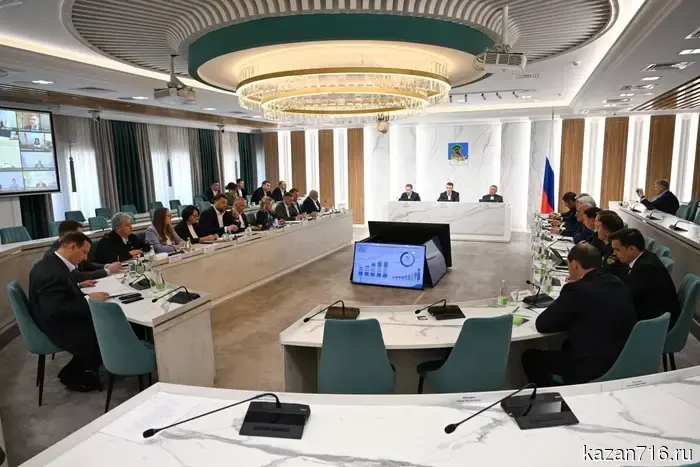
Tatarstan is preparing new waste management complexes and expanding the waste recycling system – Patrushev held an industry meeting in Chelny.
In the republic, about 1.5 million tons of municipal waste is generated annually.
The waste reform needs to be accelerated.
Today, Dmitry Patrushev, Deputy Chairman of the Government of the Russian Federation, arrived in Naberezhnye Chelny. He was met at Begishevo International Airport by the Head of Tatarstan, Rustam Minnikhanov. Together, they tested the Senat vehicle. They then visited KAMAZ, where they were shown the latest equipment, including modern garbage trucks, logging machines, and other developments. However, the main purpose of the visit was to discuss the waste management reform. Patrushev held a meeting on Incident No. 58 "Organization of the Waste Management System." "In the coming years, we need to build a huge number of infrastructure facilities (for waste management - note T-i). Overall, we need to seriously increase the pace of work," Patrushev stated. He mentioned that four complexes will be put into operation starting from early 2026 in the Leningrad and Chelyabinsk regions, the Republic of North Ossetia - Alania, and Dagestan. Moreover, several projects for waste disposal have already been implemented in Russia. According to him, an inventory of each facility is required to assess its design documentation, the quality of contractors' work, the support measures provided, and adherence to schedules. "Comprehensive control must be ensured not only over large construction projects. This also applies to other areas for which roadmaps have been approved. In particular, in 2025, entities acquired more than 62,000 containers, and another 63,000 should be purchased this year," emphasized Dmitry Patrushev. He added that the country is also continuing to update its fleet of specialized equipment, with significant assistance provided by the preferential leasing mechanism. Last year, about 1,500 garbage trucks and other equipment were purchased with its help. In conclusion, the Deputy Prime Minister instructed to create a working group in each region that will go to the sites, record the status of construction projects, and promptly resolve emerging issues. Additionally, he instructed to keep the situation with garbage collection during the resort season under special control to prevent disruptions and collapses.
"Citizens see that their voices are heard, and the authorities respond promptly to problems."
All these tasks are directly related to the national goals approved by the President of Russia, Vladimir Putin. By 2030, the country plans to ensure the processing of the entire volume of generated solid municipal waste and reduce the volume of their burial by at least 50%. In Tatarstan, work in this area is under special control. The republic has a regional headquarters for waste management issues chaired by the Head of Tatarstan, Rustam Minnikhanov. Over the years 2025-2026, 12 meetings have been held, discussing infrastructure development, the work of regional operators, and achieving industry targets. At the same time, waste management issues remain among the most sensitive for the residents of the republic. In 2025, 3,400 notifications on solid municipal waste issues were published in the "People's Control" system. The most common topics were the condition of container sites and the timeliness of garbage collection. At the same time, the number of complaints decreased by 27%, which is associated with infrastructure modernization and increased efficiency of operators' work. Nevertheless, complaints continue to be received. Since the beginning of 2026, residents have sent 2,600 messages regarding solid municipal waste to the "People's Control" system, more than 87% of which have already been resolved. The most complaints came from Kazan (1,457), Zelenodolsk (244), Laishevsky (111), Vysokogorsky (104), and Almetyevsky (85) districts. As noted by the Commissioner for Human Rights in Tatarstan, Sariya Saburskaya, the increase in the number of appeals is not in itself a negative signal. "Citizens see that their voices are heard, and the authorities respond promptly to problems. This is confirmed by the high percentage of appeals being addressed. At the same time, problems remain, so it is especially important to pay attention to areas where the highest number of unresolved issues persists, conduct targeted analysis of the causes, and develop measures to address them," she emphasized. According to Saburskaya, the highest activity of residents is traditionally observed in large cities and adjacent areas. Most complaints are resolved thanks to the interaction of regional operators, municipalities, and regulatory authorities. "This indicates that the feedback system between citizens and responsible structures is working effectively: most problems find solutions after appeals are made," noted the Commissioner for Human Rights in Tatarstan.
Why Tatarstan needs new solid waste complexes
The scale of the task remains significant. Annually, about 1.5 million tons of solid municipal waste is generated in Tatarstan. Currently, more than a quarter of this volume is directed for processing. For this purpose, five waste sorting complexes with a total capacity of 567,000 tons per year are operating in the republic. Waste burial is carried out at 34 landfills included in the state register of waste disposal facilities. According to experts, the remaining capacity of existing landfills - about 3.98 million tons - will be sufficient for approximately three years. Therefore, Tatarstan plans to build new waste management complexes in the Alekseevsky, Verkhneuslonsky, Pestrechinsky, Leninogorsk, and Tukayevsky districts. Additionally, by August 1, 2026, an updated territorial waste management scheme must be approved.
At the same time, the republic continues to eliminate objects of accumulated environmental harm. One of the largest projects in recent years has been the reclamation of the Samosyrovsky landfill in Kazan. The work was completed in 2023. Thanks to the active degassing system, the negative impact of the landfill on the air, soil, and water bodies was eliminated, and the territory itself was brought to an environmentally safe state. Another major project is the reclamation of the sludge fields of the biological treatment facilities in Kazan. Here, dewatering and disinfection of sludge, processing of accumulated waste, restoration of disturbed lands, and elimination of unpleasant odors are underway. After the work is completed, more than 140 hectares of land on the banks of the Volga are planned to be returned to economic circulation. Work is also being carried out at other sites of accumulated environmental harm. This concerns former landfills and waste disposal sites in the village of Ozyorny, the village of Prosti in the Nizhnekamsk district, the Menzelinsk district, and the village of Shemordan in the Sabinsky district. As part of the federal project "Clean Country," 37 hectares of disturbed land have been restored in Tatarstan from 2020 to 2024.
Another direction is the fight against unauthorized landfills. Since the beginning of 2026, 755 places of illegal waste disposal have been identified in the republic. 61 administrative offense rulings have been issued against violators, totaling 888,000 rubles. As of June 3, 227 such landfills have been eliminated.
New garbage trucks and digital control
Today, two regional operators are responsible for solid municipal waste management in Tatarstan - UK "PZhKKh" in the western part of the republic and "Grinta" in the eastern part. According to authorities, the operators' activities remain stable, aided by the inclusion of the solid waste management service in a single payment document.
The payment collection rate in the republic is between 94% and 98%. For residents of apartment buildings, the fee for garbage collection ranges from 119.66 to 122.95 rubles per person per month, while for residents of individual houses, it ranges from 129.80 to 133.37 rubles. For comparison, in St. Petersburg, this figure reaches 220 rubles per person per month.
For transporting waste, 471 units of specialized equipment are involved in Tatarstan. Information about the movement of garbage trucks is transmitted to the Federal State Information System for Waste Management, allowing for monitoring of route compliance and service quality.
In 2026, regional operators are updating their fleet ahead of schedule. Thanks to preferential leasing, 14 new garbage trucks were purchased against a plan of 13 units.
Another control tool has been the photo documentation of waste removal from container sites. Today, the share of such data transmission in Tatarstan is 82%, while the average figure for Russia is at 52%. This allows for quicker monitoring of the quality of carriers' work and responding to residents' appeals.
The number of containers will triple
The basic infrastructure of the waste management system in Tatarstan includes almost 26,000 container sites and about 54,000 containers. In rural areas, the bulk collection method is still widely used.
To update the infrastructure, regional operators purchase new containers annually. If about 3,000 units were purchased per year since 2020, in 2026, more than 9,500 containers are planned to be purchased.
Special attention is given to gardening associations. Since 2017, Tatarstan has had a program for creating container sites in gardening associations, under which 547 solid municipal waste collection points have been improved.
Regular garbage collection is now ensured in settlements where 99% of the republic's population lives. Exceptions are made for areas without year-round transport accessibility.
Authorities are also continuing to develop the separate waste collection system. Currently, about 25% of container sites are equipped
Другие Новости Казани (Казань716)
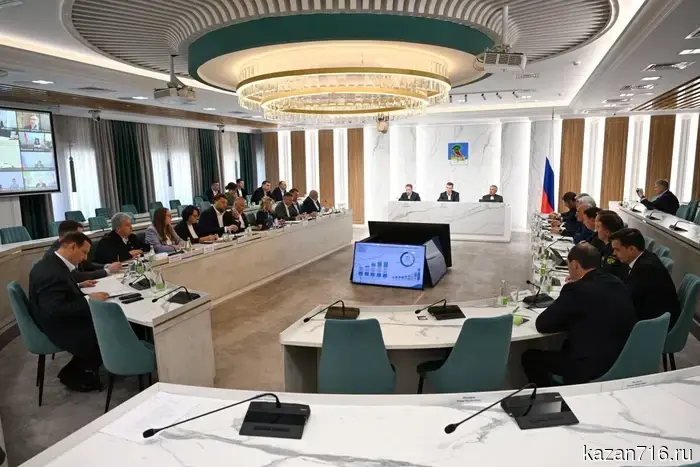 Tatarstan is preparing new waste management complexes and expanding the waste recycling system – Patrushev held an industry meeting in Chelny.
In the republic, about 1.5 million tons of municipal waste is generated annually.
The waste reform needs to be accelerated.
Today, Dmitry Patrushev, Deputy Chairman of the Government of the Russian Federation, arrived in Naberezhnye Chelny. 09.06.2026. IA Tatar-inform. Republic of Tatarstan. Kazan.
Tatarstan is preparing new waste management complexes and expanding the waste recycling system – Patrushev held an industry meeting in Chelny.
In the republic, about 1.5 million tons of municipal waste is generated annually.
The waste reform needs to be accelerated.
Today, Dmitry Patrushev, Deputy Chairman of the Government of the Russian Federation, arrived in Naberezhnye Chelny. 09.06.2026. IA Tatar-inform. Republic of Tatarstan. Kazan.
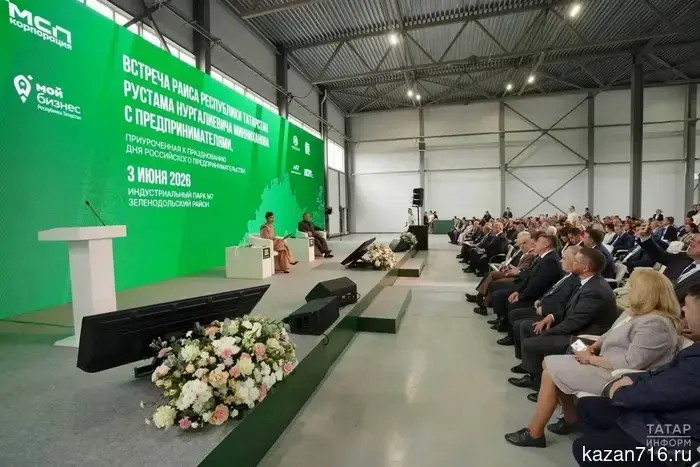 A veteran of the Special Military Operation from Tatarstan has opened his own engineering systems production.
Kirill Dmitriev, a finalist of the "Batyrlar. Heroes of Tatarstan" program, presented his products at a meeting between Rustam Minnikhanov and Tatarstan entrepreneurs. 09.06.2026. IA Tatar-inform. Republic of Tatarstan. Kazan.
A veteran of the Special Military Operation from Tatarstan has opened his own engineering systems production.
Kirill Dmitriev, a finalist of the "Batyrlar. Heroes of Tatarstan" program, presented his products at a meeting between Rustam Minnikhanov and Tatarstan entrepreneurs. 09.06.2026. IA Tatar-inform. Republic of Tatarstan. Kazan.
 "Chizh & Co", "Melnitsa" and Neuromonk Feofan: what will the new ethno-rock festival in Bolgar be like
The festival "Keepers" will host 20,000 guests
Tuvan throat singing and classic rock will be performed on one stage
On June 27, the Volga Ethno-Rock Festival "Keepers" will take place in Bolgar for the first time. 09.06.2026. IA Tatar-inform. Republic of Tatarstan. Kazan.
In Abdrakhmanovo, they celebrated Sabantuy.
As a rule, the most heartfelt celebration takes place in the village.
The prayer at the beginning of Sabantuy serves as a symbol of gratitude to the Almighty for the successful completion of spring work and a blessing for the upcoming harvest. 09.06.2026. Almetyevsk RTV. Republic of Tatarstan. Almetyevsk.
"Chizh & Co", "Melnitsa" and Neuromonk Feofan: what will the new ethno-rock festival in Bolgar be like
The festival "Keepers" will host 20,000 guests
Tuvan throat singing and classic rock will be performed on one stage
On June 27, the Volga Ethno-Rock Festival "Keepers" will take place in Bolgar for the first time. 09.06.2026. IA Tatar-inform. Republic of Tatarstan. Kazan.
In Abdrakhmanovo, they celebrated Sabantuy.
As a rule, the most heartfelt celebration takes place in the village.
The prayer at the beginning of Sabantuy serves as a symbol of gratitude to the Almighty for the successful completion of spring work and a blessing for the upcoming harvest. 09.06.2026. Almetyevsk RTV. Republic of Tatarstan. Almetyevsk.
 Lobushkin: Chinese and Russian AI models will strengthen their position in the global market.
Photo: IA SM-NEWS
June 9 – IA SM.News. Media manager Georgy Lobushkin reported that while most are discussing the latest updates of ChatGPT, a much more significant shift has occurred in the AI market: 09.06.2026. Kazan.Sm.News. Republic of Tatarstan. Kazan.
Lobushkin: Chinese and Russian AI models will strengthen their position in the global market.
Photo: IA SM-NEWS
June 9 – IA SM.News. Media manager Georgy Lobushkin reported that while most are discussing the latest updates of ChatGPT, a much more significant shift has occurred in the AI market: 09.06.2026. Kazan.Sm.News. Republic of Tatarstan. Kazan.
 Lobushkin: Chinese and Russian AI models will strengthen their position in the global market.
Photo: IA SM-NEWS
June 9 – IA SM.News. Media manager Georgy Lobushkin reported that while most are discussing the latest updates of ChatGPT, a much more significant shift has occurred in the AI market: 09.06.2026. Kazan.Sm.News. Republic of Tatarstan. Kazan.
Lobushkin: Chinese and Russian AI models will strengthen their position in the global market.
Photo: IA SM-NEWS
June 9 – IA SM.News. Media manager Georgy Lobushkin reported that while most are discussing the latest updates of ChatGPT, a much more significant shift has occurred in the AI market: 09.06.2026. Kazan.Sm.News. Republic of Tatarstan. Kazan.
Tatarstan is preparing new waste management complexes and expanding the waste recycling system – Patrushev held an industry meeting in Chelny.
In the republic, about 1.5 million tons of municipal waste are generated annually. The waste reform needs to be accelerated. Today, Dmitry Patrushev, Deputy Chairman of the Government of the Russian Federation, arrived in Naberezhnye Chelny. 09.06.2026. IA Tatar-inform. Republic of Tatarstan. Kazan.