
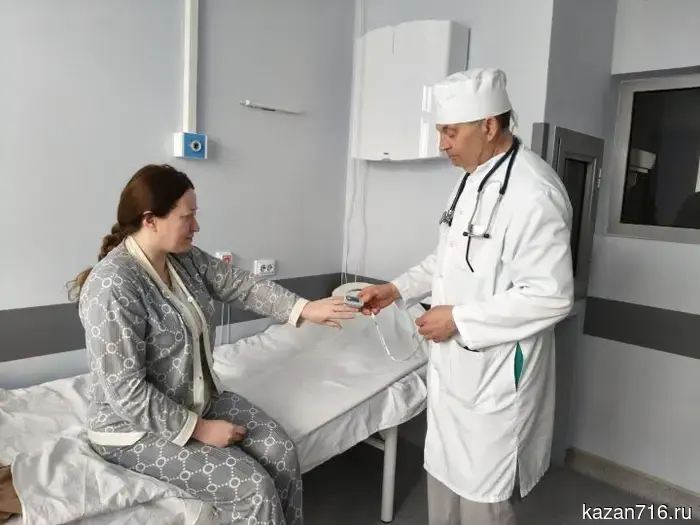
Where the air heals: A report from the infectious diseases department of the Zainsk Central District Hospital
Report from the infectious disease department of the Zainsk Central District Hospital through the eyes of a patient
Nine days of waiting for a miracle. Nine days when the mercury column stubbornly crawled towards the 40 mark, and after taking pills reluctantly slid down to 38. The cough came later, and the confidence that "It's just ARVI, it will pass by itself" melted away. It didn't pass by itself. And so, on April 12 at 4 AM, I step over the threshold of the infectious disease department of the Zainsk Central District Hospital.
Point of no return
Through the sleepy haze and body aches, I remember the first face: nurse Elena Aldoshina. She greets me and enters my details into the documents. At 4 AM, her voice sounds not irritated, but so everyday-calm that fear dissipates. Registration, direction to the ward — and here I am inside. Until this moment, I was sure I could handle it myself. But, as time showed, without medical help in this battle with fever, I was losing dry. The infectious disease department became my last stronghold.
Conditions for "especially dangerous"
When the fever subsides, you start to notice the details. A two-bed ward. A very pleasant wall color that I couldn't quite guess – either violet-blue or grayish-blue. It's warm here. So warm that I don't want to wrap myself in the hospital blanket. On the wall — a call button, which I (guiltily) immediately use to check the connection. It works instantly. Above each bed — a centralized oxygen supply system. An air conditioner on the wall. But the most interesting are the "food windows" and a special vestibule at the entrance, where a protective medical suit hangs. As the doctor later explains, these measures are a legacy of COVID and protection against especially dangerous infections. The orderly places the tray in the double window, knocks, closes her flap — contact is reduced to zero. I was lucky: my infection was not that contagious, so the nurses entered freely, albeit in masks.
Editorial note: All this technological comfort did not appear by chance. In 2024, a major renovation was completed in building No. 4. Communications, heating, sewage, windows were replaced, and supply ventilation was installed. The infectious disease department is designed for 12 beds, but there is a reserve for deployment in case of an epidemic. Thanks to the builders, administration, and chief physician — it’s easy to breathe here.
People in white coats: three stories
Each of my days was scheduled. From the first day, accompanied by nurses, I went for various ultrasounds. I took tests. In the morning, they set up IVs and gave injections. Then the orderlies came in, washed the floors, dusted, took out the trash. They brought food, took away plates. Every day new faces. Some tried to cheer me up, inquired about my well-being. And I wanted to tell the story of each of them. But, there are 15 people working in the department. They are all great professionals, and I will tell three stories.
The first — ward nurse Elena Aldoshina. Born in Gorky, but fate brought her to Zainsk. She graduated from a bookkeeping lyceum, but... was drawn to medicine. She started as an orderly, received her education at the Almetyevsk College, went through the dermatovenerology department. And then COVID hit. She was transferred to the infectious disease department.
- "It was a great practice," recalls Elena Leonidovna. "Patients' veins were thin and sunken. We placed catheters, wore protective suits ourselves. At first, it was hard, but I got used to it." When the wave of coronavirus subsided, she continued to work in this department.
The second — ward nurse Anastasia Fedotova. She is only 22. She has been in the department since 2023, the youngest. She studied at school No. 7, then graduated from the Almetyevsk Medical College. Nastya takes blood and gives injections with jewel-like precision. I feel it myself: the needle goes in softly, almost imperceptibly.
- "If the veins are sunken — we will still find them," she smiles. "I had a choice: clinic, therapy, or infectious disease department. I chose this department and do not regret it. Here I met my mentor — Farida Khamitovna Gabidullina. It was comfortable with her right away. I always knew I would go into medicine. In this job, you need to be careful and able to listen to the patient."
The third — nurse Farida Gabidullina. Her experience in this department is 27 years. This is her first and only place of work.
"My mother, Gaynutdinova Rakiya Akhmetvaleevna, worked as a paramedic in the village of Shikmamayevo for 40 years. I saw how she helps people from childhood and dreamed of the same. In the infectious disease department, kindness and honesty are the main things. You have to love the patients; without that, it’s impossible."
Medical Dynasty: Head Anvar Nabiullin
The main person in the department who managed to unite a strong team of professionals is the head. Anvar Saubanovich Nabiullin — a distinguished infectious disease physician of the Republic of Tatarstan, holder of the highest category. In Zainsk, he is a respected doctor who has saved many lives. Interestingly, his father founded a medical dynasty.
His father, Sauban Nabiullovich, was a phthisiatrist. In the turbulent 90s, he practically eliminated tuberculosis in the Zainsk district, working in a 100-bed dispensary. His mother, Fagima Khabibullovna, started in surgery and retired from the physiotherapy office. His daughter Alsu is an oncological dermatologist in Kazan. His niece Gulnara is an anesthesiologist-resuscitator at the vascular center in Nizhnekamsk, and her husband Almaz is also an anesthesiologist. In total, there are 6 active doctors in the family and two students — future medical workers.
"My father instilled in me a love for medicine," says Anvar Saubanovich. "By the third year, I knew: I would be an infectious disease physician."
He considers his teachers Anatoly Nikolaevich Nyukhniy and Regina Fedorovna Soldatenkova. He himself is a legendary figure for Zainsk. A person who has not lost humanity over decades of work, saved many lives, and treated many, especially during the years when the coronavirus infection gained momentum.
- "When there was coronavirus, we still didn't have repairs; the conditions were different. But, thanks to coordinated actions and well-prepared specialists — we held out. In those years, we deployed beds, and doctors Irina Isaeva and Regina Usmanova worked with us and helped a lot. I am grateful to everyone who helped and continues to help people," he says.
The head nurse is Galina Leonidovna Pavlova. A graduate of the Menzelinsk School of 1982. She has gone from the reception room to the head nurse of the infectious disease department. She is responsible for the coordination of the work of nurses and orderlies.
"Our team is friendly, everyone is responsible, it’s easy to work," she says. "I believe I have realized my potential. I always wanted to work in the medical field and help people."
About viruses and vaccination
Taking the opportunity, I ask Anvar Saubanovich about what is currently concerning everyone.
- Anvar Saubanovich, federal media keep scaring us with new viruses. What really threatens Zainsk?
- I wouldn't say we have everything that large cities have. West Nile fever has so far bypassed us, although it occurs in the Volgograd or Saratov regions. We have cases of tick-borne encephalitis and Lyme disease. But these are isolated cases; there is no mass occurrence. People have become knowledgeable: they immediately seek help after a tick bite, and we conduct preventive treatment.
- The Ministry of Health of Russia is currently conducting a Week of Awareness about the importance of immunoprophylaxis. What is your attitude towards vaccinations?
- Positive. If possible, one should get vaccinated.
- What should modern people definitely get vaccinated against?
- First of all, for lovers of the forest, hunting, and fishing — against tick-borne encephalitis. This is a very serious disease that leads to disability. I recommend vaccinating children against rotavirus infection — it can be severe. Adults would also benefit. For frequent bronchopulmonary diseases — the "Pneumo-23" vaccine. Especially for those over 65 and children who often get sick.
- Why is this so important?
- Most infections are viral. Any viral infection causes immune depression, lowers immunity. And then bacteria that normally "sit" and wait for their time activate. The result: bronchitis, otitis, sinusitis, pneumonia. Vaccination is insurance against this vicious circle.
Recovery
I leave the infectious disease department as a different person — not only healthy but also having understood where the thin line lies between overconfidence and trust in professionals. The COVID times became a "fiery baptism" for these people. The department held out. It received a new building, new ventilation, and central oxygen. But its main wealth is the people. The golden hands of Nast
Другие Новости Казани (Казань716)
 The Kazan court sentenced the "heiress" of the late millionaire Kanashova to 4.5 years.
In the debates, the prosecutor requested a sentence of 5 years and 4 months in a general regime colony.
Photo: 04.23.2026. Real time. Republic of Tatarstan. Kazan.
"Books for Our Own": An initiative has started in Kazan to collect military-patriotic literature for the soldiers of the special operation.
Source of the photo: the website of the National Library of the Republic of Tatarstan. It was organized at the initiative of a member of the Public Chamber of the Russian Federation, Olga Pavlova, with the support of the Kazan local branch of the United Russia party and Tatarstan on April 23, 2026. United Russia. Republic of Tatarstan. Kazan.
The hidden opposition to Mishustin views the economic crisis as a window of opportunity.
Photo: Official website of the President of the Russian Federation kremlin.ru
April 23 – IA SM.News. 04.23.2026. Kazan.Sm.News. Republic of Tatarstan. Kazan.
The Kazan court sentenced the "heiress" of the late millionaire Kanashova to 4.5 years.
In the debates, the prosecutor requested a sentence of 5 years and 4 months in a general regime colony.
Photo: 04.23.2026. Real time. Republic of Tatarstan. Kazan.
"Books for Our Own": An initiative has started in Kazan to collect military-patriotic literature for the soldiers of the special operation.
Source of the photo: the website of the National Library of the Republic of Tatarstan. It was organized at the initiative of a member of the Public Chamber of the Russian Federation, Olga Pavlova, with the support of the Kazan local branch of the United Russia party and Tatarstan on April 23, 2026. United Russia. Republic of Tatarstan. Kazan.
The hidden opposition to Mishustin views the economic crisis as a window of opportunity.
Photo: Official website of the President of the Russian Federation kremlin.ru
April 23 – IA SM.News. 04.23.2026. Kazan.Sm.News. Republic of Tatarstan. Kazan.
 Putin commented on the shutdown of mobile internet in major cities.
President of Russia Vladimir Putin commented on the "problems and failures" in the operation of the internet in major cities during a meeting with the country's Government. 04.23.2026. IA Tatar-inform. Republic of Tatarstan. Kazan.
Putin commented on the shutdown of mobile internet in major cities.
President of Russia Vladimir Putin commented on the "problems and failures" in the operation of the internet in major cities during a meeting with the country's Government. 04.23.2026. IA Tatar-inform. Republic of Tatarstan. Kazan.
 The Kazan court sentenced the "heir" of the late millionaire Kanashova to 4.5 years.
In the debates, the prosecutor requested a sentence of 5 years and 4 months in a general regime colony.
Photo: 04.23.2026. Real time. Republic of Tatarstan. Kazan.
The Kazan court sentenced the "heir" of the late millionaire Kanashova to 4.5 years.
In the debates, the prosecutor requested a sentence of 5 years and 4 months in a general regime colony.
Photo: 04.23.2026. Real time. Republic of Tatarstan. Kazan.
 A resident of Chelny won half a million from the executive committee for a Mercedes damaged in a pothole.
The City Court of Naberezhnye Chelny ordered the executive committee of the auto city to compensate the driver whose car was damaged due to the poor condition of the roads. 23.04.2026. KAMAZ News. Republic of Tatarstan. Naberezhnye Chelny.
A resident of Chelny won half a million from the executive committee for a Mercedes damaged in a pothole.
The City Court of Naberezhnye Chelny ordered the executive committee of the auto city to compensate the driver whose car was damaged due to the poor condition of the roads. 23.04.2026. KAMAZ News. Republic of Tatarstan. Naberezhnye Chelny.
Where the air heals: A report from the infectious diseases department of the Zainsk Central District Hospital
Report from the infectious disease department of the Zainsk Central District Hospital through the eyes of a patient Nine days of waiting for a miracle. 04/23/2026. News of Zainsk. Republic of Tatarstan. Zainsk.